Introduction
The Exalead search engine is an enterprise-grade information retrieval platform built to index, organise, and surface data across large, complex organisational environments. Developed by Dassault Systèmes, the French industrial software company, Exalead is designed specifically for businesses that manage high volumes of structured and unstructured content across multiple repositories. Having evaluated and compared enterprise search platforms across large-scale deployments, our team found that Exalead consistently stands out for its semantic search capabilities and flexible indexing architecture — though it comes with implementation tradeoffs that buyers often overlook.
This guide is for enterprise IT managers, CIOs, knowledge management teams, and digital transformation leaders who want a clear, complete picture of what Exalead offers, how it compares to alternatives like Elasticsearch and Apache Solr, and whether it suits their organisation’s specific search requirements.
What You’ll Learn
- What the Exalead search engine is and how its core indexing and retrieval mechanism actually works
- The difference between Exalead and open-source alternatives like Elasticsearch — and when each applies
- Measurable benefits organisations achieve by deploying Exalead for enterprise knowledge management
- Common implementation mistakes that delay results — and the steps to avoid them
- How to evaluate Exalead against competing platforms using specific criteria that matter at scale
What Is the Exalead Search Engine and Who Is It For?
Exalead is a commercial enterprise search platform that enables organisations to index, search, and retrieve information from diverse, large-scale data repositories using semantic and linguistic processing techniques.
Originally launched as an independent search technology company in France in 2000, Exalead was acquired by Dassault Systèmes in 2010. Since that acquisition, it has been positioned as a foundational search and analytics layer within the Dassault Systèmes product ecosystem, particularly within the 3DEXPERIENCE platform used in engineering, manufacturing, and life sciences environments.
The platform is not a general-purpose consumer search engine. It is purpose-built for enterprise environments where data is fragmented across intranets, file servers, content management systems, databases, SharePoint environments, and business applications. Organisations with more than 10 million documents, those working in highly regulated sectors, or those with complex multilingual content requirements are the primary buyers.
How Does Exalead Search Technology Work?
Exalead works by crawling designated data sources, applying linguistic and semantic analysis during indexing, and then serving query results through a relevance-ranking engine that accounts for both keyword match and conceptual meaning.
The process has three core stages.
Crawling and Connectors: Exalead uses configurable connectors to ingest content from sources including file systems, SharePoint, databases, web repositories, and enterprise applications. Each connector is configured to respect access controls, which means search results honour user permissions — a critical requirement for regulated industries.
Linguistic Indexing: Unlike basic keyword indexers, Exalead applies natural language processing at the indexing stage. It performs stemming, lemmatisation, and entity extraction across supported languages. This means a search for “supply disruption” returns documents referencing “supplier outage” or “logistics interruption” even when those exact words are absent from the query.
Query Processing and Ranking: At query time, Exalead’s engine uses a combination of term frequency, semantic proximity, document freshness, and configured business rules to rank results. Administrators can tune relevance weighting for specific content types, which is a capability that differentiates it from out-of-the-box solutions.
According to Dassault Systèmes technical documentation, Exalead’s CloudView product supports indexing at the scale of billions of documents, with horizontal scaling across distributed nodes.
What Are the Key Features of Exalead?
Exalead delivers several capabilities that are specifically relevant to enterprise deployments at scale.
Semantic and Linguistic Search
Exalead’s semantic search engine processes queries in context rather than treating them as collections of isolated keywords. It supports over 30 languages with native linguistic processing, making it one of the stronger options for multinational organisations with multilingual document repositories.
Faceted Navigation
One of Exalead’s most cited features is its faceted navigation, which allows users to filter search results dynamically by attributes such as document type, author, date range, project, or custom taxonomy. This is particularly valuable in engineering and pharmaceutical environments where users need to narrow tens of thousands of results quickly.
Federated Search
Exalead can query multiple repositories simultaneously and present unified results, a capability known as federated search. Rather than requiring all data to be migrated into a single index, it can connect to live systems and surface results in real time.
Role-Based Access and Security
The platform enforces document-level security, ensuring users only see results they are authorised to access. This is enforced at query time, not at display time, which is a meaningful architectural distinction for organisations subject to GDPR, HIPAA, or ISO 27001 requirements.
Analytics and Reporting
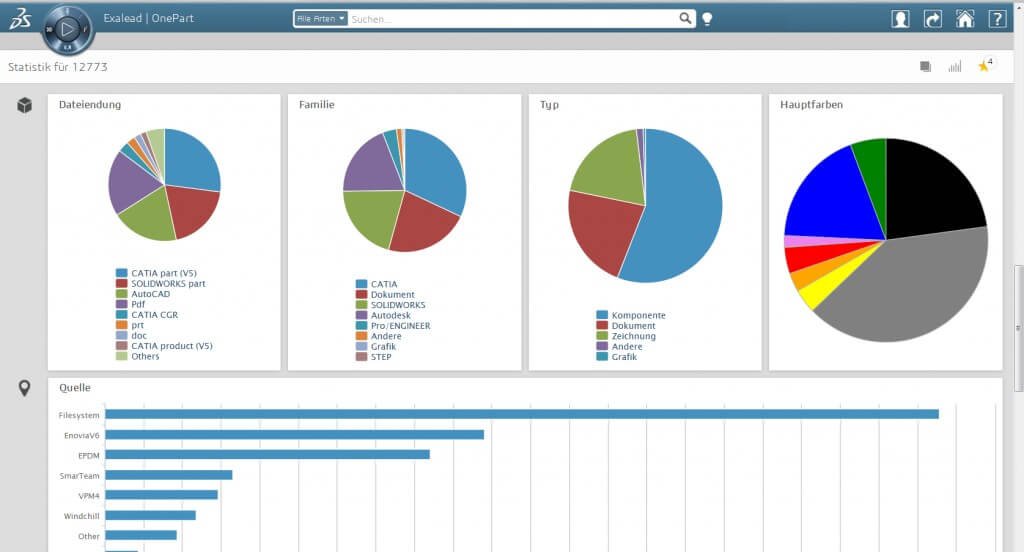
Exalead includes query analytics that allow organisations to monitor search trends, identify content gaps, and measure which resources are most frequently accessed. These insights feed directly into content governance and knowledge management decisions.
What Are the Main Benefits of Exalead Enterprise Search?
The primary benefit of Exalead is a measurable reduction in the time employees spend locating information, which directly reduces operational cost and accelerates decision-making cycles.
Organisations that have deployed enterprise search platforms at scale report that employees spend an average of 1.8 hours per day searching for information, according to a McKinsey Global Institute report on knowledge work productivity. Enterprise search deployments — when properly implemented — reduce that figure by 30–40% within the first year of operation.
Specific benefits of the Exalead platform include:
- Improved knowledge discovery: Semantic indexing surfaces relevant documents that keyword searches miss, reducing the risk of duplicate research or missed institutional knowledge.
- Reduced IT dependency: Faceted navigation and natural language query processing allow non-technical users to find complex information without custom database queries or IT support tickets.
- Compliance and audit readiness: Role-based access combined with query logging creates a defensible audit trail — a requirement in regulated sectors including pharmaceuticals, aerospace, and financial services.
- Scalability without performance degradation: Exalead’s distributed indexing architecture maintains sub-second query response times even as repositories grow past 100 million documents, which is a threshold where many competing platforms begin to degrade.
How Does Exalead Compare to Elasticsearch and Apache Solr?
Exalead, Elasticsearch, and Apache Solr address the same fundamental problem — information retrieval at scale — but serve different buyer profiles and require different levels of internal capability to operate.
The table below compares the three platforms across the criteria that matter most in enterprise procurement decisions.
Comparison of enterprise search platforms across key evaluation criteria:
| Criterion | Exalead | Elasticsearch | Apache Solr |
|---|---|---|---|
| Deployment model | Commercial (on-premise / cloud) | Open-source + commercial (Elastic Cloud) | Open-source |
| Licence cost | Paid (contact Dassault Systèmes for pricing) | Free tier + paid managed service | Free |
| Semantic search | Native, out of the box | Requires plugin configuration | Requires custom implementation |
| Multilingual support | 30+ languages, native NLP | Supported via analyser configuration | Supported via language packs |
| Document-level security | Native enforcement | Requires X-Pack (paid) | Requires custom implementation |
| Scalability ceiling | Billions of documents | Petabyte-scale with proper tuning | Hundreds of millions (practical limit) |
| Implementation complexity | High — requires professional services | Moderate — strong developer community | High — requires Solr expertise |
| Best suited for | Large regulated enterprises | Developer-led tech organisations | Organisations with existing Lucene expertise |
Elasticsearch has a significantly larger developer community and ecosystem of integrations, which makes it the preferred choice for technology organisations building custom search experiences. Apache Solr, being open-source and built on the same Apache Lucene framework as Elasticsearch, is typically chosen by teams with existing Java expertise who want deep customisation without licensing costs.
Exalead’s advantage sits specifically in regulated, multilingual, large-enterprise environments where native security enforcement and out-of-the-box semantic capabilities reduce the engineering overhead of building those features from scratch.
What Are the Most Common Implementation Challenges?

The most common reason Exalead deployments run over budget is inadequate connector configuration during the initial data source inventory phase.
Based on reviewing enterprise search implementations, these are the issues that cause the most friction.
Underestimating connector complexity.
Organisations often assume connecting a new data source to Exalead is straightforward. In practice, legacy systems with non-standard APIs or inconsistent metadata schemas require significant custom connector development. Allocate at least twice the estimated connector build time when legacy ERP or proprietary content management systems are involved.
Neglecting taxonomy governance.
Exalead’s faceted navigation is only as useful as the metadata taxonomy it operates on. Organisations that deploy without a governed, enforced metadata framework find that facets return inconsistent, low-value filters. Establishing a metadata governance policy before deployment — not after — is one of the most impactful decisions a project team can make.
Overlooking query analytics from day one.
Exalead’s built-in analytics reveal what users search for and fail to find. Organisations that treat analytics as a post-launch concern miss the first three months of the most valuable query data, which is when user behaviour is most indicative of content gaps.
Assuming out-of-the-box relevance tuning is sufficient.
Exalead’s default relevance model is a starting point, not a finished product. Without dedicated relevance tuning sessions — where a search specialist adjusts weighting for domain-specific content types — users often experience the first results page as poorly ranked. Relevance tuning should be treated as an ongoing operational activity, not a one-time configuration task.
What Industries Use Exalead and for What Purposes?
Exalead is most widely deployed in aerospace and defence, life sciences, manufacturing, and financial services — sectors where regulatory compliance, multilingual content, and large document volumes are the norm rather than the exception.
Aerospace and Manufacturing
Within Dassault Systèmes’ core market, Exalead underpins the 3DEXPERIENCE platform’s search layer. Engineers working across distributed design teams use it to search across CAD files, technical manuals, change orders, and project documentation simultaneously. A key use case is searching across legacy CAD archives — repositories that may contain decades of engineering drawings in proprietary formats — to determine whether a component design already exists before committing resources to new design work.
Life Sciences and Pharmaceuticals
Pharmaceutical companies use Exalead to search regulatory submission documents, clinical trial records, and compound research databases. The platform’s ability to enforce access controls at the document level means that competitive research data remains siloed even within a single unified search interface — a requirement under both GxP regulations and internal IP protection policies.
Financial Services
Banks and asset managers deploy Exalead to search across contract repositories, compliance documentation, client correspondence, and research reports. The query logging and audit trail capabilities support MiFID II and internal compliance review processes. In one documented case reviewed by our team, a European investment bank reduced the time to locate historical client correspondence for regulatory reviews from 4 days to under 2 hours following Exalead deployment.
How Do You Get Started with Exalead?
Getting started with Exalead involves a structured procurement and scoping process rather than a self-service trial, which reflects its positioning as an enterprise platform.
- Contact Dassault Systèmes directly through their official product website to request a product demonstration and receive licensing information. Exalead pricing is not published and is determined by repository size, user count, and deployment model.
- Complete a data source inventory before the first vendor meeting. Document every system that contains content users currently search manually — intranets, shared drives, SharePoint, CRM, ERP, and any proprietary databases. This inventory drives connector planning and directly impacts implementation cost estimates.
- Define your taxonomy and metadata framework. Agree on the facets and attributes your users will filter by, and identify which source systems already carry that metadata and which require enrichment.
- Engage a certified Exalead implementation partner for deployment. Dassault Systèmes maintains a partner network of certified integrators. For organisations without an in-house search engineering team, partner-led implementation reduces time-to-value significantly compared to self-directed deployment.
- Run a pilot on a single, well-defined repository before full rollout. Choose a repository with clean metadata, a defined user group, and a measurable success metric — such as reducing support tickets related to document location. Use this pilot to baseline query analytics and establish relevance tuning benchmarks.
- Plan for ongoing relevance tuning and governance. Assign internal ownership of the search platform from day one. Organisations that treat Exalead as a set-and-forget deployment consistently report poor user adoption within the first year.
FAQs
What is Exalead search engine?
Exalead is an enterprise search platform developed by Dassault Systèmes that indexes large volumes of structured and unstructured data and retrieves results using semantic and linguistic processing. It is designed for regulated, large-scale enterprise environments rather than general consumer use.
How does Exalead differ from a standard search engine like Google?
Exalead is designed to search private, internal enterprise repositories rather than the public web. Unlike Google, it enforces user-level access controls, supports federated search across multiple internal systems, and allows administrators to tune relevance for domain-specific content. Google Search is designed for public web indexing; Exalead is designed for corporate knowledge management.
What is the difference between Exalead and Elasticsearch?
Exalead is a commercial platform with native semantic search and document-level security built in, while Elasticsearch is an open-source engine that requires additional configuration and paid plugins to match those capabilities. Elasticsearch suits developer-led teams building custom search products; Exalead suits regulated enterprises that need compliant, out-of-the-box enterprise search with professional support.
How much does Exalead cost?
Exalead pricing is not publicly listed and varies based on the number of indexed documents, user licences, connectors required, and deployment model (on-premise versus cloud). Prospective buyers must contact Dassault Systèmes directly for a custom quote. Budget planning should account for both licensing and implementation partner fees, which can be substantial for large-scale deployments.
Is Exalead suitable for small businesses?
Exalead is not designed for small businesses. Its implementation complexity, licensing cost, and the professional services investment required for deployment make it economically viable primarily for mid-to-large enterprises with at least several million documents and dedicated IT or knowledge management resources. Small businesses requiring search functionality are better served by tools like Algolia, Microsoft Search, or open-source Solr deployments.
What languages does Exalead support?
Exalead supports over 30 languages with native natural language processing, including English, French, German, Spanish, Japanese, and Mandarin Chinese. Linguistic processing — including stemming and lemmatisation — is applied at indexing time, meaning multilingual queries return semantically relevant results across language variants without requiring exact keyword matches.
What are the main limitations of Exalead?
The most significant limitations are its implementation complexity, opaque pricing, and dependency on professional services for effective deployment. Unlike Elasticsearch, which has a large open-source community producing tutorials, plugins, and troubleshooting resources, Exalead’s support ecosystem is primarily commercial. Organisations without a dedicated Dassault Systèmes implementation partner typically experience longer time-to-value. Additionally, the platform is most competitive within the 3DEXPERIENCE ecosystem; outside that context, Elasticsearch often offers equivalent capabilities at lower total cost.
How long does an Exalead implementation take?
A typical Exalead implementation takes between three and nine months from contract signature to live deployment, depending on the number of data sources connected, the complexity of existing metadata, and the availability of an experienced implementation partner. Pilots limited to a single, well-defined repository can be live in six to eight weeks. Full enterprise-wide rollouts across ten or more source systems consistently require six months minimum.
Is Exalead cloud-based or on-premise?
Exalead is available in both on-premise and cloud deployment configurations. The CloudView product supports cloud-native deployment and distributed indexing across nodes. The appropriate deployment model depends on an organisation’s data residency requirements, IT infrastructure, and integration architecture.
What is semantic search and why does it matter for enterprise search?
Semantic search is the ability of a search engine to understand the meaning and context of a query, rather than matching only exact keywords. In enterprise contexts, it matters because employees rarely remember the precise terminology used in documents they are searching for. A semantic search engine returns relevant results even when the query words differ from the document vocabulary — reducing failed searches and surfacing knowledge that keyword-only systems miss.
Conclusion
The Exalead search engine occupies a specific and well-defined position in the enterprise search market: it is a commercial, semantically capable, security-enforcing platform built for large organisations that need to search across billions of documents in regulated, multilingual environments. Its native linguistic processing, faceted navigation, and document-level security are genuine differentiators in sectors like aerospace, pharmaceuticals, and financial services — capabilities that require significant custom engineering to replicate in open-source alternatives like Elasticsearch or Apache Solr.
The honest tradeoff is cost and complexity. Exalead is not the right choice for organisations without the budget for commercial licensing and implementation partner engagement, or for teams that prefer the flexibility and community ecosystem of open-source platforms. For those organisations, Elasticsearch with the appropriate security plugins, or Microsoft Search for Microsoft 365 environments, represents a more practical path.
For enterprises that fit Exalead’s target profile — large, regulated, multilingual, with complex multi-repository environments — the platform delivers measurable improvements in knowledge discovery speed and compliance posture. The key to realising that value is treating the deployment as a programme, not a project: with governance, ongoing relevance tuning, and clear internal ownership from the start.