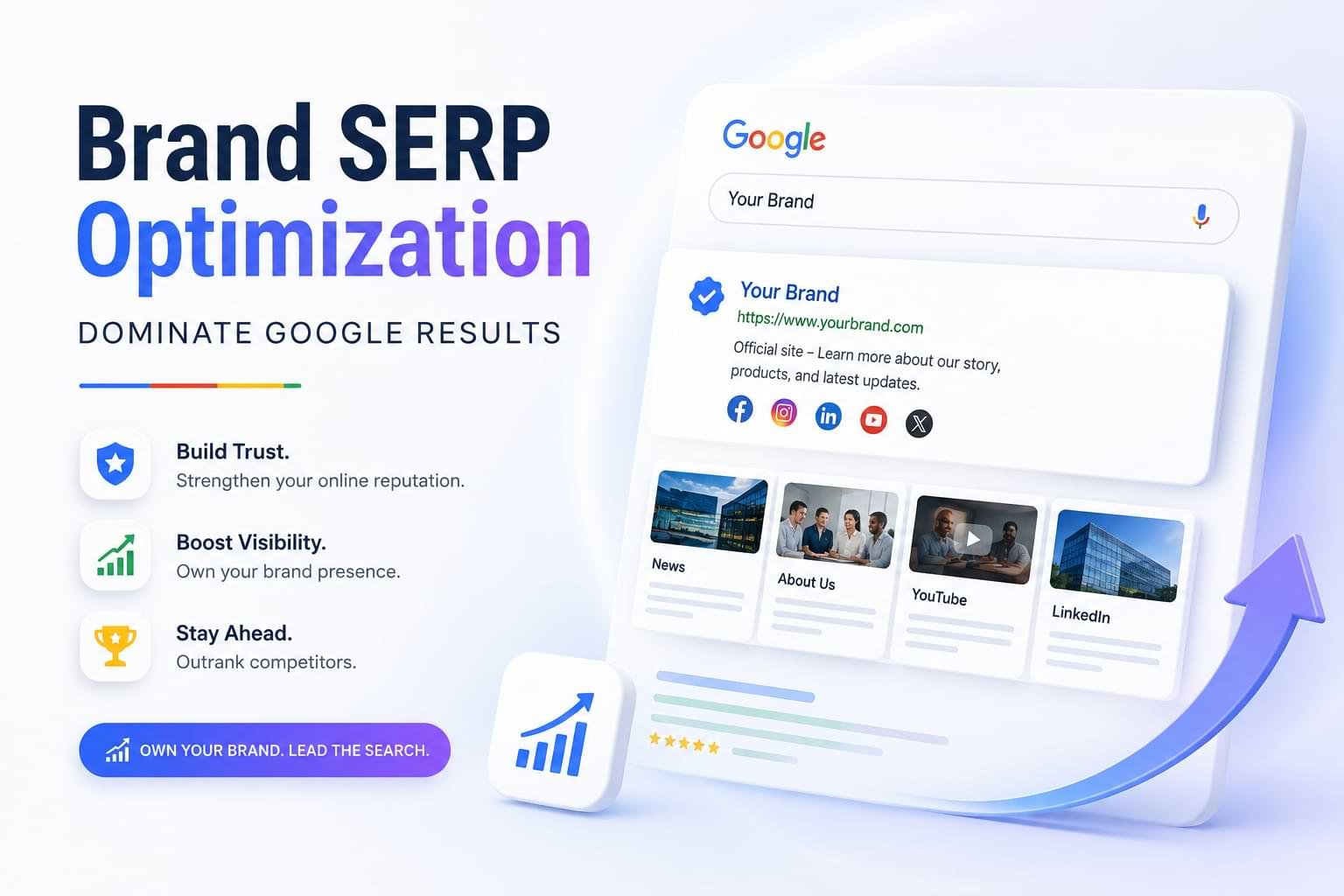
WHAT YOU’LL LEARN
- How to audit and control every element of your brand’s Google search results page
- Which SERP features matter most for brand protection and conversion optimization
- Step-by-step strategies to push down negative content and elevate owned properties
- How to claim and optimize your Google Knowledge Panel for maximum credibility
- Proven tactics to prevent competitors from hijacking your branded search traffic
Introduction
Brand SERP optimization is the process of controlling what appears when someone searches for your company name on Google. Your brand’s search results page represents your digital front door—it’s often the first impression potential customers, investors, or employees see.
Unlike traditional SEO that targets product or service keywords, brand SERP optimization focuses specifically on the results triggered by your brand name. This includes your website, social profiles, review sites, news mentions, knowledge panels, and unfortunately, sometimes competitor ads or negative content.
When managed strategically, your brand SERP becomes a conversion asset that builds trust, answers questions, and guides visitors to the right destination. When neglected, it can undermine reputation, confuse prospects, and leak traffic to competitors.
This guide is for SEO specialists, digital marketers, brand managers, and business owners who want to take full control of their branded search presence.
Your brand SERP is too important to leave to chance. Let’s explore how to optimize it systematically.
What Is Brand SERP Optimization and Why Does It Matter?
Brand SERP optimization is the strategic process of managing and improving all elements that appear on the search engine results page when users search for your brand name.
Your brand SERP includes organic listings, knowledge panels, image packs, video carousels, social media profiles, review snippets, People Also Ask boxes, and paid ads. Each element either strengthens or weakens your brand’s digital presence.
Why Your Brand SERP Matters More Than You Think
Most businesses focus exclusively on ranking for product or industry keywords. But your brand SERP has a unique role: it’s where high-intent visitors land after hearing about you.
These searchers already know your name. They’re researching whether to trust you, buy from you, or work with you. What they see in those ten blue links directly impacts conversion rates.
A well-optimized brand SERP accomplishes three goals: it builds credibility through consistent, professional listings; it protects reputation by controlling the narrative; and it captures traffic by occupying maximum real estate.
The Business Impact of Brand SERP Control
When you own page one of your brand SERP, you control the customer journey. Visitors see your website, your social proof, your content, and your messaging—not competitor ads, outdated information, or negative reviews from years ago.
For agencies and consultants, demonstrating brand SERP optimization capability differentiates your service offering. It bridges traditional SEO and SEO reputation management into one cohesive strategy.
How Does Brand SERP Optimization Work?
Brand SERP optimization works by strategically creating, claiming, and promoting digital properties that Google recognizes as authoritative sources about your brand.
Google’s algorithm determines what appears on your brand SERP based on relevance, authority, and user intent. Your job is to signal to Google which properties deserve visibility and which entities are officially connected to your brand.
The Three Pillars of Brand SERP Control
First, entity recognition: Google must understand your brand as a distinct entity in its Knowledge Graph. This requires structured data, consistent NAP (name, address, phone), and clear entity relationships across platforms.
Second, content ownership: You need to create and claim properties that rank for your brand name. This includes your website, social profiles, YouTube channel, LinkedIn page, and potentially owned media like Medium or Substack.
Third, authority building: Each property must demonstrate relevance and authority through content quality, engagement signals, and backlinks. A dormant Twitter account won’t rank; an active one with branded content will.
How Google Decides What Ranks for Your Brand
Google evaluates three signals when ranking brand SERP results: string matching (does the content mention your exact brand name?), entity association (is this property officially connected to your brand?), and authority (does this source have credibility?).
That’s why your official website almost always ranks #1—it has perfect string matching, verified entity connection, and typically the strongest domain authority.
But positions 2-10 are competitive. Social platforms, review sites, news outlets, and third-party directories all compete for visibility. Your optimization determines which ones appear.
What Are the Key Elements of a Brand SERP?
A brand SERP typically contains eight to twelve distinct elements, each serving different user intents.
Understanding these components helps you prioritize optimization efforts based on what actually appears for your brand searches.
Organic Listings
These are the traditional blue links. For brand searches, you should aim to control at least 6-8 of the top 10 positions through owned or earned properties.
Owned properties include your main website, blog subdomain, help center, careers page, and regional sites. Earned properties include social profiles, review platforms, news mentions, and industry directories.
Knowledge Panel
The Knowledge Panel appears on the right side of desktop results (or top of mobile) and serves as your brand’s digital business card.
It displays your logo, description, social links, contact information, and related entities. Google sources this data from Wikidata, your website’s structured data, and verified Google Business Profile.
Site Links
Site links are indented sub-listings that appear beneath your main website result. They give users quick access to key pages like About, Contact, Products, or Pricing.
Google generates these automatically based on site structure and user behavior, but you can influence them through internal linking, clear navigation, and structured data.
Image Pack
Brand searches often trigger an image carousel featuring photos associated with your brand: logos, products, team photos, or event images.
These images come from your website, social media, news articles, and Google Images. Optimizing file names, alt text, and image structured data improves representation here.
Video Carousel
If your brand has video content on YouTube or other platforms, Google may display a video carousel showing branded videos.
This is valuable real estate for product demos, customer testimonials, or brand story content. Optimized titles, descriptions, and transcripts improve visibility.
Reviews and Ratings
Review snippets from Google Business Profile, Trustpilot, G2, or industry-specific platforms often appear prominently.
These build or damage trust instantly. Managing review generation, responding professionally, and claiming all review profiles is critical.
People Also Ask
The PAA (People Also Ask) box shows related questions users ask about your brand. These often include “Who owns [Brand]?”, “Where is [Brand] located?”, or “Is [Brand] legit?”
Answering these questions with structured content on your website increases your chances of occupying these spots.
Paid Ads
Competitor ads targeting your brand name represent lost traffic and revenue. Some brands see competitors bidding on their brand terms to intercept high-intent searches.
While you can’t prevent this entirely, you can bid on your own brand terms defensively or file trademark complaints where applicable.
How Do You Audit Your Current Brand SERP?
Auditing your brand SERP reveals what you control, what needs improvement, and what threatens your reputation.
Start by opening an incognito browser window and searching your exact brand name. Screenshot the entire first page of results.
Map Every Visible Element
Create a spreadsheet listing every result, its position, domain, content type, and ownership status.
Categorize each result as: owned (you control it), earned (third-party but positive), neutral (directory listings, Wikipedia), or negative (complaints, competitor content, outdated information).
Calculate your “brand SERP occupancy rate”—the percentage of page one you control. A healthy brand SERP shows 60-80% owned properties.
Evaluate Your Knowledge Panel
Check whether you have a Knowledge Panel. If yes, audit its accuracy: Is the logo correct? Is the description current? Are the social links working?
If you don’t have a Knowledge Panel, this becomes a priority. It signals Google doesn’t fully recognize you as a verified entity yet.
Check for Reputation Threats
Look specifically for negative content: complaint sites, bad reviews, critical blog posts, or outdated news articles.
Note their position. Anything on page one requires immediate attention. Content on page two should be monitored but is lower priority.
Test Variations of Your Brand Name
People search brands in different ways: with or without “Inc”, with common misspellings, or with location modifiers like “Brand Name Chicago.”
Audit each variation. Results can differ significantly, revealing gaps in your optimization strategy.
Monitor Competitor Ad Presence
Refresh the search multiple times across several days to see if competitors consistently bid on your brand name.
Document which competitors appear, their ad copy, and what offers they’re promoting. This intelligence informs defensive bidding strategy.
What Strategies Control and Improve Your Brand SERP?
Controlling your brand SERP requires creating rankable properties, optimizing existing assets, and strategically suppressing negative content.
These five strategies give you the framework to dominate your branded search results.
Strategy 1: Create and Optimize Owned Properties
Launch properties specifically designed to rank for your brand name: a company blog, YouTube channel, LinkedIn Company Page, help center, or newsroom.
Each property should include your exact brand name in the title tag, URL, and H1. Publish branded content regularly to signal freshness and relevance.
For example, a monthly CEO update on LinkedIn or weekly product tips on YouTube both establish these profiles as active brand assets worthy of ranking.
Strategy 2: Implement Entity-Based Structured Data
Add Organization schema to your homepage with your official name, logo, social profiles, and contact information.
This structured data helps Google understand your brand as an entity and populates your Knowledge Panel. Use consistent NAP data across all platforms.
Include sameAs properties linking to all official social profiles. This creates explicit entity connections that improve brand SERP cohesion.
Strategy 3: Build Strategic Backlinks to Owned Properties
Don’t just link to your homepage—build links to secondary properties you want to rank.
If your LinkedIn page isn’t ranking, get industry blogs or press releases to link to it. If your YouTube channel needs visibility, embed videos on partner sites.
Authority flows through links. Distributing that authority across your branded ecosystem elevates each property’s ranking potential.
Strategy 4: Occupy High-Authority Third-Party Platforms
Claim and optimize profiles on platforms that already rank well for brand searches: Crunchbase, Wikipedia, YouTube, LinkedIn, Facebook, Instagram, Twitter, and industry-specific directories.
These platforms have domain authority you can leverage. A complete, active profile often ranks higher than a dormant owned property.
Consistency is key. Use identical brand names, descriptions, and visual identity across all platforms to reinforce entity recognition.
Strategy 5: Suppress Negative Content with Positive Content
You usually can’t delete negative content, but you can push it to page two by elevating positive content.
If a negative review site ranks position 7, your goal is to promote owned properties into positions 6-10, pushing the negative result down.
Create new branded content, build links to existing properties, and increase engagement signals on your social platforms. Over time, fresh, authoritative content outranks stale negative mentions.
How Does Knowledge Panel Optimization Impact Your Brand SERP?
Your Knowledge Panel serves as Google’s official summary of your brand, making it the most valuable single element of your brand SERP.
A well-optimized Knowledge Panel builds instant credibility, provides key information at a glance, and establishes your brand as a verified entity in Google’s Knowledge Graph.
How to Claim and Verify Your Knowledge Panel

If you already have a Knowledge Panel, click “Claim this knowledge panel” or “Suggest an edit” to begin the verification process.
Google will ask you to verify ownership through your official website or social profiles. Once verified, you can directly edit certain information like social links, logo, and descriptions.
If you don’t have a Knowledge Panel yet, focus on entity establishment: create a Wikidata entry, implement Organization schema on your site, get mentioned in news articles, and maintain consistent NAP across major platforms.
Optimizing Knowledge Panel Content
Your Knowledge Panel description should concisely explain what your company does, for whom, and what makes you distinct.
Avoid marketing language. Write factually: “Brand Name is a B2B SaaS platform that helps enterprise sales teams automate proposal generation” works better than “Brand Name is the leading innovative solution.”
Update your logo to high-resolution format. Ensure all social links are current and active. Add your official website, contact information, and location if applicable.
Using Your Knowledge Panel for Reputation Management
Your Knowledge Panel often displays customer questions, reviews, and related entities.
Monitor these sections weekly. Respond to questions, address review themes, and ensure related entities (founders, products, locations) are accurate and positive.
If negative entities appear (like “Brand Name controversy”), you may need to create positive content that redefines entity associations over time.
What Are Common Brand SERP Mistakes to Avoid?
Even experienced marketers make brand SERP errors that damage visibility and reputation.
Avoiding these seven mistakes saves months of recovery work.
Mistake 1: Ignoring Brand SERP Until There’s a Crisis
Most businesses don’t audit their brand SERP until negative content appears or a competitor starts bidding on their name.
By then, you’re playing defense. Proactive brand SERP optimization prevents problems and positions you to respond quickly when issues arise.
Mistake 2: Inconsistent Brand Names Across Platforms
Using “Brand Co.” on LinkedIn, “Brand Company” on Facebook, and “Brand Inc.” on your website confuses Google’s entity recognition.
Choose one official name and use it identically everywhere. Variations dilute entity strength and fragment your brand SERP.
Mistake 3: Creating Profiles and Abandoning Them
A dormant Twitter account with no posts since 2019 won’t rank. Worse, it signals neglect.
Only create properties you can maintain. One active YouTube channel beats five abandoned social profiles.
Mistake 4: Not Monitoring Competitor Ad Bidding
Some brands don’t realize competitors are bidding on their brand names until they lose significant traffic.
Set up a weekly alert to check for competitor ads on your brand searches. Defensive bidding or trademark enforcement may be necessary.
Mistake 5: Ignoring Visual Brand Consistency
Your brand SERP includes images, social profile pictures, and Knowledge Panel logos. Inconsistent visuals create confusion.
Use the same logo, color scheme, and visual identity across all properties. Visual consistency reinforces brand recognition.
Mistake 6: Overlooking Review Platform Optimization
Unclaimed profiles on Trustpilot, G2, Glassdoor, or Yelp can rank prominently with outdated information or unaddressed negative reviews.
Claim every review platform where your brand appears. Respond professionally to reviews and encourage satisfied customers to share feedback.
Mistake 7: Forgetting to Optimize for Brand Name Variations
Users search “Brand,” “Brand Company,” “Brand login,” “Brand reviews,” and “Brand vs Competitor.”
Your brand SERP strategy should cover the primary brand name and key variations. Each may show different results requiring specific optimization.
How Do You Get Started with Brand SERP Optimization?
Starting brand SERP optimization requires a structured approach focused on quick wins and long-term positioning.
Follow this four-phase implementation plan to take control of your branded search results in 90 days.
Phase 1: Audit and Prioritize (Week 1-2)
Conduct the brand SERP audit described earlier. Document every result, categorize ownership, and identify reputation threats.
Prioritize your top three opportunities: maybe you need a Knowledge Panel, or you have a negative review in position 5, or a competitor ad is appearing consistently.
Phase 2: Claim and Optimize Existing Properties (Week 3-4)
Claim every profile where your brand already appears: Google Business Profile, social platforms, review sites, and directories.
Update logos, descriptions, contact information, and social links for consistency. Implement Organization schema on your homepage.
This phase delivers immediate improvements with minimal effort.
Phase 3: Create Strategic New Properties (Week 5-8)
Identify gaps in your brand SERP. If you don’t rank socially, create and optimize a LinkedIn Company Page and YouTube channel.
If you lack content properties, launch a company blog or newsroom. Publish 4-6 pieces of branded content per property to establish freshness.
Build internal links from your homepage to these new properties to pass authority.
Phase 4: Monitor, Maintain, and Expand (Week 9+)
Set up monthly brand SERP monitoring. Track position changes, new results, and competitor activity.
Continue publishing content on owned properties. Build backlinks strategically to properties that need ranking boosts.
Respond to reviews, update Knowledge Panel information, and expand coverage to brand name variations.
Brand SERP optimization is ongoing. Maintain momentum with a regular cadence of content, engagement, and technical updates.
FAQs
Is brand SERP optimization the same as reputation management?
No, brand SERP optimization is a component of reputation management, specifically focused on controlling search results. Reputation management encompasses broader activities like review generation, crisis response, and social listening across all platforms, while brand SERP optimization targets the specific real estate of your Google search results page.
How long does it take to see results from brand SERP optimization?
You can see initial improvements within 2-4 weeks from claiming profiles and implementing structured data. Significant changes like ranking new properties or pushing down negative content typically take 60-90 days. Establishing a Knowledge Panel from scratch may take 3-6 months depending on your brand’s current entity recognition.
Can I remove negative content from my brand SERP?
You generally cannot remove legitimate negative content unless it violates Google’s policies or contains false information. Instead, focus on suppression strategies: create and promote positive owned properties to push negative results to page two. For defamatory or false content, legal removal requests through Google’s legal process may be appropriate.
Should I bid on my own brand name in Google Ads?
Yes, if competitors are bidding on your brand name or if you want to control the complete above-the-fold experience. Branded PPC (pay-per-click) campaigns typically have low CPCs (cost per click) and high conversion rates. They also prevent competitors from capturing traffic from users specifically searching for you. Monitor competitor ad activity to determine if defensive bidding is necessary.
What’s the difference between brand SERP optimization and traditional SEO?
Traditional SEO targets generic product or service keywords where you’re competing for discovery. Brand SERP optimization targets your brand name specifically, where searchers already know who you are. Brand SERP focuses on reputation, entity recognition, and conversion optimization rather than traffic generation. The tactics overlap but serve different strategic goals.
How do I get a Google Knowledge Panel for my brand?
Establish your brand as a recognized entity by creating a Wikidata entry, implementing Organization schema markup on your website, maintaining consistent NAP across platforms, earning mentions in news publications, and building strong social media presence. Google must recognize you as a notable entity before triggering a Knowledge Panel. Once it appears, claim and verify it for editing rights.
Do social media profiles really rank for brand searches?
Yes, social profiles from platforms like LinkedIn, Facebook, Twitter, YouTube, and Instagram frequently rank on page one for brand searches. These platforms have high domain authority, and Google recognizes them as official brand properties when properly claimed and maintained. Active profiles with regular content typically rank higher than dormant ones.
How often should I audit my brand SERP?
Conduct a comprehensive audit quarterly and a quick review monthly. Set up automated monitoring with tools that alert you to position changes, new results, or competitor ads. Immediately audit if you launch a rebrand, experience a PR crisis, or notice sudden traffic changes in branded search campaigns.
Can I optimize my brand SERP if I have a common company name?
Yes, but it requires stronger entity signals. Implement detailed Organization schema with unique identifiers. Add location modifiers to your brand name where appropriate. Build strong topical authority in your specific niche. Google distinguishes entities through context—industry, location, related entities, and content themes help differentiate you from similarly named brands.
What tools help with brand SERP monitoring?
Use Google Search Console to track branded keyword impressions and clicks. Brand24, Mention, or Google Alerts monitor new mentions. SEMrush and Ahrefs track SERP position changes. For Knowledge Panel management, use Google’s “Claim this knowledge panel” feature. For visual monitoring, BrandVerity tracks competitor ad bidding on your brand terms.
Conclusion
Your brand SERP is the digital front door to your business. When someone searches your company name, what appears in those results directly influences whether they trust you, click through, and ultimately convert.
Brand SERP optimization gives you control over that critical first impression. By strategically claiming properties, implementing entity-based structured data, creating valuable content, and monitoring competitor activity, you transform your branded search results from a passive listing into an active conversion asset.
Start with the audit. Understand what you currently control and where vulnerabilities exist. Then systematically claim, optimize, and elevate the properties that deserve visibility while suppressing elements that damage reputation.
The businesses that thrive in 2026 recognize that brand SERP optimization bridges traditional SEO, SEO reputation management, and conversion optimization into one cohesive strategy. It’s not a one-time project—it’s an ongoing discipline that compounds value over time.