Introduction
SEO is not dead. What’s dead is the version of SEO that stops at ranking a blue link. AI Overviews and AI Mode pull most of their answers from pages that already rank well in Google’s top 10, which means the work of earning that rank still matters — it’s just no longer the whole job. If you’ve been told to abandon SEO for something called GEO or AEO, you were told half the story.
Every year brings a new reason to declare SEO dead — mobile-first indexing, voice search, featured snippets, and now generative AI. Each time, the pages that kept ranking were the ones that kept doing the fundamentals well: fast, crawlable sites, content that actually answers the query, and real signals of experience behind the byline.
Nothing about that pattern broke in 2026. What changed is the distribution of the answer, not the underlying mechanics of earning it.
Is SEO Dead in 2026? What the Data Actually Shows
No. Ahrefs’ research into AI Overview sourcing found that roughly 38% of AI Overview citations come from pages already sitting in Google’s top 10 organic results, and that share climbs further once you widen the window past position 10. That’s not a coincidence.
Google’s generative features aren’t a separate ranking system running on different rules — they’re built on top of the same retrieval and quality systems that produce ordinary search results.
Google says as much directly in its own AI optimization documentation: the guidance for showing up in AI Overviews is, functionally, the guidance for showing up in search at all. There’s no secret file, no special tag, no backdoor.
Here’s the part most “SEO is dead” posts skip: Google shipped a Generative AI performance report inside Search Console in mid-2026. It shows which of your pages are getting pulled into AI Overviews, how often those appearances turn into clicks, and which queries are triggering generative answers instead of standard listings.
That report is the actual answer to “is SEO dead” for your specific site — not a general industry take, your own data.
Why “SEO Is Dead” Keeps Trending Anyway
Two things are true at once, and the panic comes from mixing them up. First, zero-click search is real — a growing share of searches get answered directly on the results page, especially simple factual queries, so fewer people click through for those.
Second, organic search still drives the largest share of overall website traffic of any channel, and that hasn’t flipped.
What changed isn’t whether organic visibility matters. It’s which queries still send a click and which ones get fully answered before the user scrolls. A “what is technical SEO” query might get satisfied by an AI Overview.
A query like “SEO agency Miami bilingual clients” almost never does, because it requires judgment, comparison, and trust — the exact things a generic AI summary can’t fully resolve for the reader. Informational queries compress. Commercial and local queries mostly don’t.
So when someone asks “is SEO dead,” what they usually mean is “did my traffic just drop because of AI Overviews.” Sometimes yes, on a handful of informational pages.
Rarely, on the pages that actually drive revenue. Conflating the two is how an entire industry convinced itself SEO is dead based on a decline that only hit a fraction of its query types.
What AI Overviews Actually Changed About Search
AI Overview is Google’s AI-generated summary that appears above traditional results for many queries, built by pulling and synthesizing content from pages Google already trusts enough to rank.
AI Mode is the newer, more conversational search experience that runs a fuller back-and-forth, often fanning a single question out into several related sub-queries behind the scenes before answering.
Neither one replaced the underlying index. What they changed is extractability — whether your page is written in a way a language model can lift a clean, self-contained answer from without misquoting or skipping you.
A page that buries its actual answer in paragraph four, under a vague header like “Overview,” is easy for a human to skim past and just as easy for an AI system to skip pulling from.
That’s the real shift. Ranking gets you into the candidate pool. Structure — direct answers, clear headers, defined terms, named sources — decides whether you’re the one who actually gets cited or paraphrased into someone else’s answer.
There’s a second, less-discussed problem sitting underneath extractability: attribution. Independent research into AI citation patterns has found that a large share of AI-generated answers pull from a page’s content without ever naming the brand behind it — what’s been called the “ghost citation” problem.
The page gets used, the reader gets an answer, and the business gets nothing. The fix isn’t complaining to the AI. It’s writing claims that name the actor, the number, and the source in the same sentence, so there’s nothing to strip out when the answer gets synthesized.
“Egochi’s audit of a Miami service-business client found X” survives extraction. “A recent audit found X” doesn’t.
SEO vs. GEO vs. AEO: What’s Actually Different
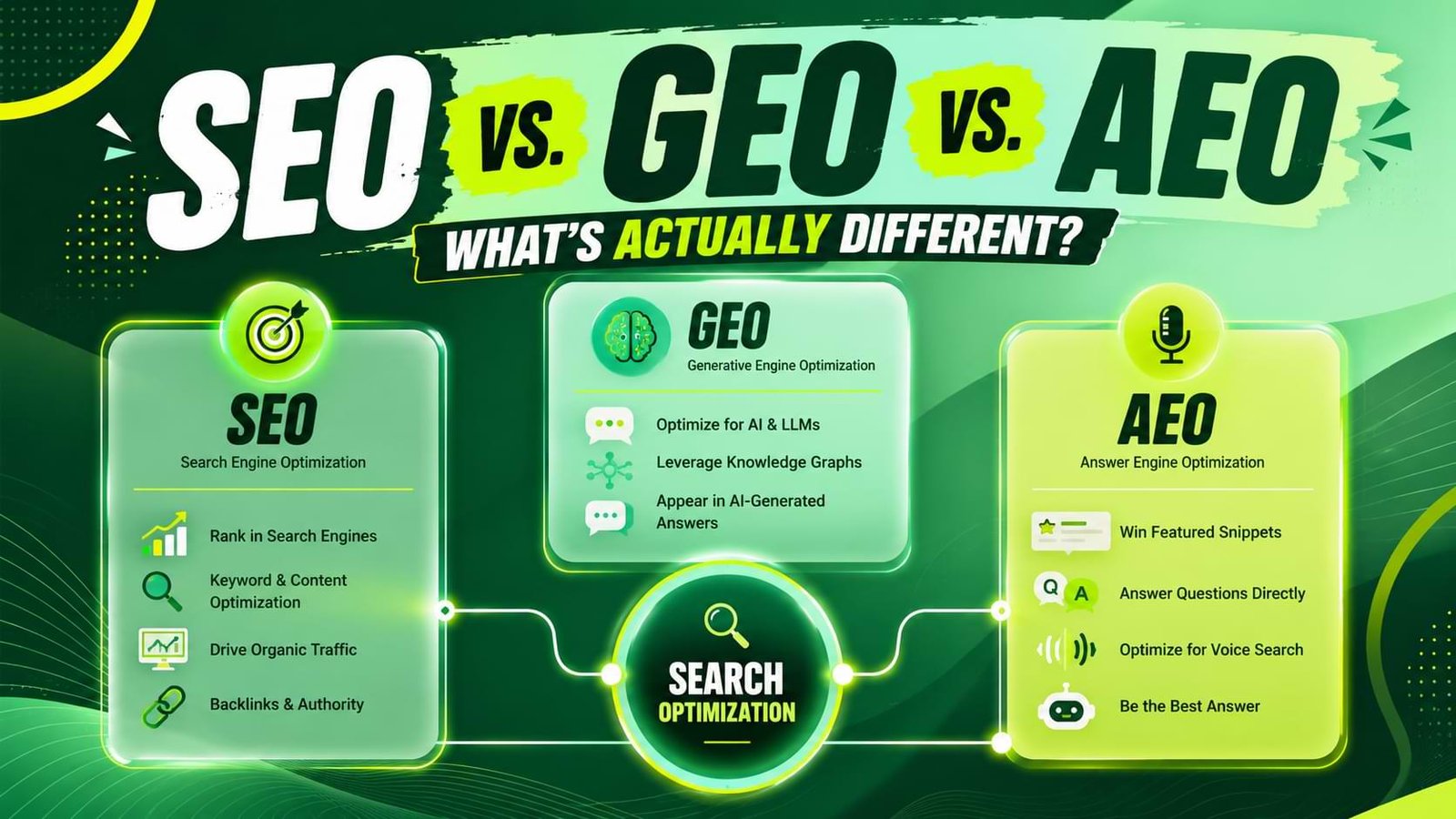
People throw these three terms around interchangeably, which is part of why the “SEO is dead” panic spreads. They’re related, not identical.
SEO (Search Engine Optimization) is the underlying discipline: technical crawlability, page speed, Core Web Vitals (Google’s measurements of loading speed, interactivity, and visual stability), internal linking, and content that matches real search intent.
AEO (Answer Engine Optimization) is writing and structuring content so it can directly answer a specific question — clear H2s phrased as questions, one-sentence definitions, scannable lists.
GEO (Generative Engine Optimization) is the layer on top of both: formatting and sourcing choices that make already-ranking, already-answer-shaped content easy for a generative model to extract and, ideally, credit to your brand by name.
The relationship only works in one direction. GEO without SEO underneath it doesn’t function — AI engines rarely cite pages that aren’t already earning organic trust. SEO without any AEO or GEO layer still ranks, but increasingly gets summarized without credit. You need the foundation before the layer on top of it does anything.
SEO vs. GEO — in practice:
SEO decides whether Google trusts your page enough to rank it in the first place: crawlability, page experience, backlink profile, topical relevance. GEO decides whether that already-trusted page gets extracted cleanly once it’s in the candidate pool.
A page can win the first battle and lose the second — rank on page one, never get pulled into an AI Overview — because it was written for a 2019 SERP, not a 2026 one.
This is also where schema markup earns its keep, even though Google is explicit that no special schema is required for AI Overview eligibility.
Organization, Article, and LocalBusiness schema don’t force a citation, but they do give both traditional crawlers and AI systems a clean, structured signal about who published a claim and where the business is located — which matters more, not less, once attribution becomes the thing you’re fighting for.
What We Changed on a Real Client Site After AI Overviews Arrived

Muhammad Rehan Iqbal, Co-Founder and Content Strategy & Web Development Lead at Egochi Miami SEO Agency, ran a version of this exact audit on one of the agency’s own service pages earlier this year.
The page ranked, converted occasionally, but had zero AI Overview presence for its core cluster of queries — a familiar pattern on pages written before generative search existed.
The fix wasn’t a rewrite from scratch. It was structural: a direct one-sentence answer placed immediately under the H1 instead of three paragraphs of throat-clearing, question-phrased H2s replacing label-style headers like “Our Approach,” and named tools and sources swapped in for vague lines like “studies show.” Nothing about the underlying offer changed.
The verification step matters as much as the fix itself. Rehan pulled the before/after directly from the Search Console Generative AI performance report — checking impressions and clicks attributed to AI Overview appearances for the target query cluster,
Not just overall rank position, since rank alone doesn’t tell you whether AI systems are actually surfacing the page. That’s the audit step most agency blog posts skip entirely: they claim a lift happened without naming what they measured it with.
The same audit process applies whether the site belongs to a Miami plumber, a bilingual real estate broker, or a pet-care resource site. Pull the report, isolate the query cluster that matters commercially (not every query — the ones that actually convert),
Check whether AI Overview appearances are happening at all, then restructure the specific pages that are missing but should qualify. It’s a repeatable four-step process, not a one-off trick, which is the difference between an audit and a guess.
Is SEO Still Alive? The Traffic Sources AI Can’t Replace
Yes, and the clearest evidence is what AI Overviews haven’t touched: commercial-intent and local-intent search. Queries with words like “near me,” “cost,” “vs.,” or a city name attached still route almost entirely to standard results and Google Business Profile listings, because they require comparing real, current options — something a generative summary is structurally bad at doing responsibly.
For a Miami-based service business, that’s the majority of the queries that actually turn into revenue. “SEO agency Miami” isn’t a query Google can fully answer inside a generated summary; it’s a query someone asks right before they pick up the phone or fill out a form.
AI Overviews compress informational search. They have not compressed decision search, and decision search is where local businesses live.
Backlinko’s traffic-share research has consistently found organic search driving well over half of measurable website traffic across industries — the largest single channel by a wide margin, ahead of paid, social, and direct combined in most verticals.
That figure predates AI Overviews and hasn’t collapsed since they launched, because zero-click compression concentrates on a specific slice of queries, not the whole search graph. For a bilingual, South Florida market specifically, add one more layer:
AI Overviews are noticeably less consistent on Spanish-language and mixed-language local queries than on English informational ones, which keeps traditional bilingual SEO — content, listings, and reviews in both languages — relevant a while longer than the English-only conversation suggests.
Will AI Replace SEO? Why the Premise Is Wrong

The premise assumes AI search and SEO are two separate systems competing for the same job. They aren’t. AI Mode and AI Overviews are consumers of the search index, not replacements for it — they still need crawled, indexed, trustworthy pages to synthesize answers from,
Google has said its generative features sit on top of core Search ranking and quality systems rather than beside them.
Crawler access is the plainest proof of this. Sites now need to actively allow bots like GPTBot, PerplexityBot, and Google’s own crawlers rather than blocking them by default, or they simply won’t be eligible for citation in generative answers at all — regardless of how good the content is.
AI didn’t remove the need for technical SEO fundamentals like crawlability. It added a second reason to get them right.
Is SEO Dead in the Future? What Changes and What Doesn’t
Some parts of SEO will keep shrinking. Pure informational content — “what is,” “how does X work,” simple definitions — will keep getting absorbed into zero-click and AI Overview answers, and chasing thin traffic on those queries alone is a losing long-term bet.
Other parts get more important, not less: technical crawlability, genuine first-hand experience in the content, named sources instead of vague claims, and local trust signals like reviews and Google Business Profile accuracy.
Google’s January 2025 Search Quality Rater Guidelines update told raters to specifically flag content that reads as “template-like or could have been written by any of a thousand tools” — which means the future penalty isn’t for using AI to help draft content, it’s for publishing content indistinguishable from what any competitor’s AI tool could also produce.
The future of SEO rewards specificity, not effort for its own sake.
How to SEO-Proof (and AI-Proof) Your Site: A 6-Step Checklist

- Pull your Search Console Generative AI performance report and identify which queries already trigger AI Overviews for your site, and whether you’re being cited on them.
- Rewrite your top pages’ first 100 words to directly answer the page’s core question — no scene-setting, no restating the title as sentence one.
- Convert label-style H2s into question-style H2s (“What Does Local SEO Cost?” instead of “Pricing”).
- Name your sources. Replace “studies show” and “experts agree” with the actual study, tool, or person.
- Confirm AI crawlers aren’t blocked. Check robots.txt for GPTBot, PerplexityBot, and ClaudeBot access if AI citation is a goal.
- Add one non-commodity element per page — a real number, a real before/after, a genuinely original take a competitor’s AI tool couldn’t generate in thirty seconds.
FAQs
Is SEO dead in the future?
No, but its shape keeps shifting. Pure informational content will keep losing clicks to AI Overviews and zero-click answers, while technical SEO, local trust signals, and first-hand expertise become more valuable, not less, as more competitors publish AI-assisted content that looks the same.
Is SEO still alive?
Yes. Organic search remains the largest single driver of website traffic across most industries, and commercial or local queries — the ones that actually produce leads and sales — are largely untouched by AI Overviews, which are concentrated on simple informational questions.
Is SEO dead in 2026?
No. Roughly 38% of AI Overview citations come from pages already ranking in Google’s top 10 organic results, and Google’s own documentation confirms its generative features are built on core Search ranking systems rather than a separate one. Ranking well is still the entry ticket.
Will AI replace SEO?
No, because AI search tools depend on the same crawled, indexed content that SEO produces. AI Mode and AI Overviews synthesize answers from pages that already earned trust and rank through SEO fundamentals; without that underlying work, there’s nothing for the AI system to cite.
Conclusion
SEO is not dead, and it isn’t the same job it was three years ago either. Both things are true, and pretending otherwise — in either direction — is how businesses end up either abandoning a channel that still drives most of their traffic, or ignoring the structural changes that decide whether AI systems cite them or quietly summarize their competitor instead.
The businesses winning right now aren’t the ones chasing every new acronym or panicking every time a headline declares SEO dead.
They’re the ones still doing SEO fundamentals well — crawlability, real content, genuine trust signals — and adding the extractability layer on top: direct answers, named sources, first-hand experience, and claims written so they survive being quoted by a machine.
That combination is what separates a business that’s still ranking a year from now from one still arguing on LinkedIn about whether SEO is dead.