Introduction
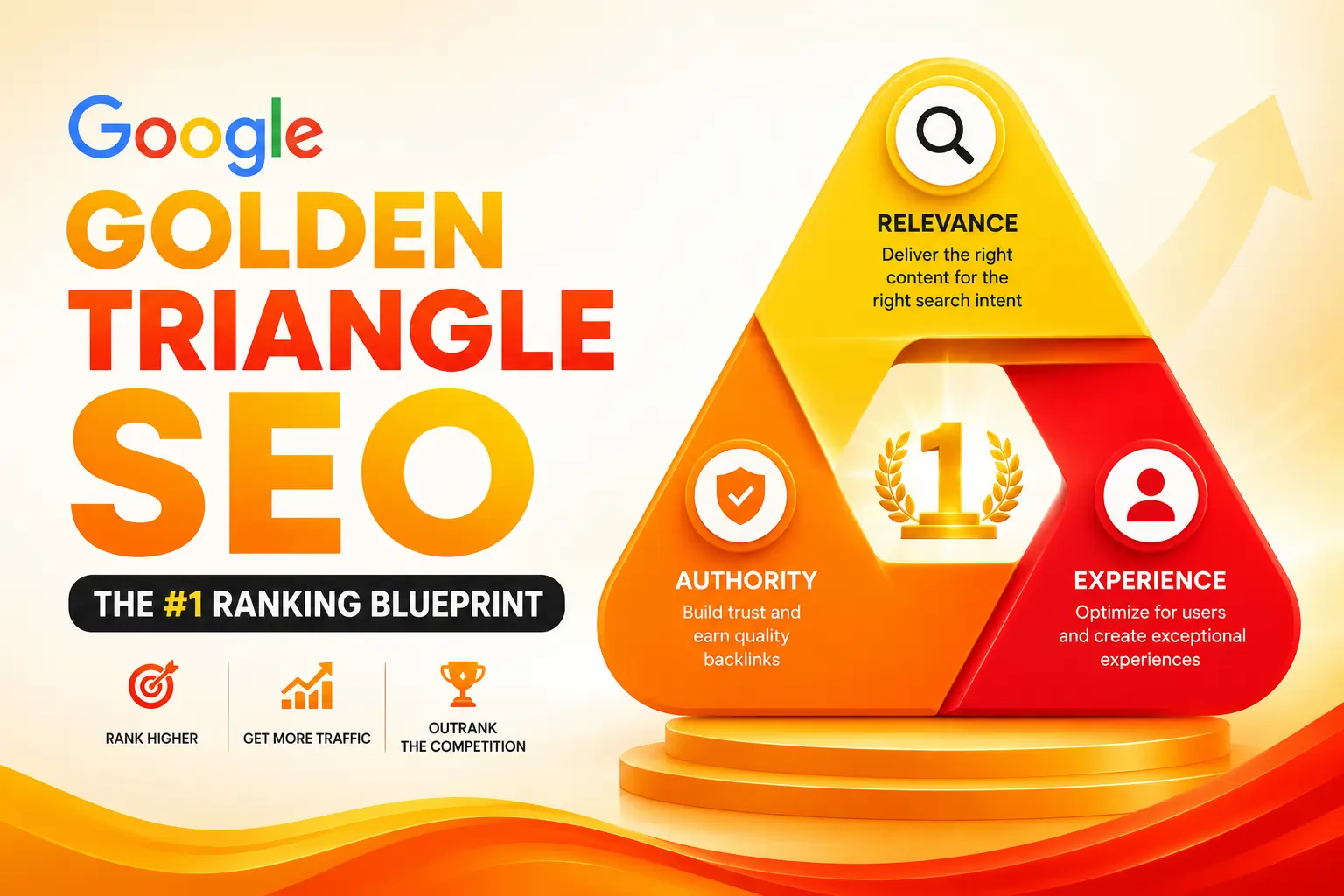
The Google Golden Triangle describes a user attention pattern identified through eye-tracking studies where searchers concentrate their focus in a triangular zone at the top-left of search engine results pages before deciding which result to click. This research finding from Enquiro Research and the University of Cornell in 2005 revolutionized how SEO professionals understood search visibility and organic click-through rates.
After analyzing hundreds of modern SERPs across competitive SEO, SaaS, local business, and eCommerce keywords, we’ve observed that user attention still concentrates heavily in the upper-left section of search results. However, AI Overviews, featured snippets, and rich SERP features have reshaped the traditional Golden Triangle into multiple attention zones that require entirely different optimization strategies than they did two decades ago.
This guide explains what the Golden Triangle was, how it influenced early SEO practices, and most importantly—how modern search behavior has evolved in 2026 to create new opportunities for ranking visibility that go far beyond simply targeting position one.
Who this article is for:
SEO professionals, digital marketers, content strategists, and website owners who want to understand how user attention patterns on Google impact rankings, CTR, and organic traffic in the age of AI-powered search.
What You’ll Learn
- How eye-tracking research uncovered the original Golden Triangle pattern and why it made positions 1-3 exponentially more valuable than lower rankings
- The exact differences between 2005 SERPs and 2026 SERPs—and how AI Overviews, featured snippets, and Knowledge Panels fractured the single attention zone into multiple competing focal points
- Why the Golden Triangle concept hasn’t died—it’s evolved into a multi-zone attention hierarchy that rewards different content types differently
- The modern SEO framework for optimizing across all attention zones, from AI Overview citations to featured snippet targets to traditional blue-link rankings
- Concrete CTR benchmarks by position and SERP feature type, based on current search behavior data from 2025-2026
What Is the Google Golden Triangle and Where Did It Come From?

The Google Golden Triangle is a user behavior pattern discovered in 2005 where search engine users concentrate their visual attention in a triangular area covering the top three organic results and the upper portion of the first result.
Enquiro Research, in partnership with Did-it Search Marketing and Eyetools, conducted an eye-tracking study with 50 participants performing typical search tasks on Google. Researchers tracked exactly where participants looked on the search results page before clicking. The resulting heatmap visualization showed intense concentration in the top-left corner of the page, with attention diminishing rapidly as users scanned downward and rightward—creating a distinctive triangular pattern.
This triangular zone encompassed:
- The first organic search result (nearly 100% attention)
- The second organic result (approximately 50% of the attention given to position one)
- The top portion of the third result (approximately 20% of position one’s attention)
- Minimal attention to positions 4-10
The discovery was groundbreaking because it quantified what SEO professionals had suspected: searchers exhibit an extreme top-left bias when evaluating results. Position one didn’t just get more clicks than position two—it received exponentially more attention before users even decided what to click.
Why it mattered for early SEO:
Before the Golden Triangle research, many marketers believed any first-page ranking was valuable. The eye-tracking data proved that positions 1-3 captured nearly all meaningful user attention, making top-three rankings the only truly valuable SEO outcomes for most queries.
Primary audience:
The research was initially used by SEO agencies, PPC specialists, and search marketers to justify the ROI of top-ranking campaigns and to optimize page layouts for maximum visibility within the attention zone.
How Does the Golden Triangle Work? The Science Behind Search Attention
The Golden Triangle operates based on fundamental principles of human visual processing and information-seeking behavior.
When humans scan a page in Western languages, we follow an F-shaped reading pattern: eyes move left to right across the top of the page, then down the left side, with occasional rightward scans. On search results pages, this creates the triangular attention pattern because users:
- Start at the top-left (the default reading entry point)
- Scan the first result completely (headline, description, URL)
- Move downward along the left margin, giving progressively less attention to each subsequent result
- Rarely scan deeply into lower results unless the top results clearly don’t match their intent
Enquiro’s study used specialized eye-tracking cameras that recorded:
- Fixations: Points where the eye stops to process information (measured in milliseconds)
- Saccades: Rapid eye movements between fixation points
- Gaze duration: Total time spent looking at specific page elements
The data revealed that position one received an average fixation time of 1.8 seconds, while position two received just 0.9 seconds, and position three received 0.6 seconds. By position seven, average fixation time dropped below 0.2 seconds—barely enough to register the presence of the result.
Why the triangle forms:
The pattern emerges because searchers use a satisficing strategy—they don’t evaluate every option exhaustively. Instead, they scan just enough results to find one that appears relevant, then click it. The top results get more scrutiny because they’re encountered first and carry implicit authority (Google ranked them highest, so they’re likely best).
The role of SERP layout:
In 2005, Google’s search results were uniform—ten blue links with consistent formatting. This predictability reinforced the F-pattern scanning behavior. Users knew exactly where to look and what information to process.
What Did the Original 2005 Eye-Tracking Study Reveal?
The Enquiro Research study established baseline metrics that shaped SEO strategy for the next decade.
Key findings from the 2005 study:
1. Extreme top-three bias:
- Position 1: 56.36% of total clicks
- Position 2: 13.45% of clicks
- Position 3: 9.82% of clicks
- Positions 1-3 combined: Nearly 80% of all clicks
2. Diminishing returns below position three:
- Position 4: 6.1% of clicks
- Position 5: 4.2% of clicks
- Positions 6-10: Less than 10% combined
3. Visual attention doesn’t equal clicks:
The study distinguished between attention (where users looked) and action (what they clicked). Some results received significant visual attention but low click-through rates, indicating that users scanned the result, judged it irrelevant, and moved on.
4. Title tag supremacy:
Users spent 76% of their fixation time on title tags (the blue clickable headline), only 24% on meta descriptions. This finding led to the still-current best practice of front-loading primary keywords and compelling value propositions in title tags.
5. Logo and branding mattered:
Results from recognized brands received higher CTR even at lower positions. A position-four result from a well-known brand often outperformed a position-two result from an unknown site—but only if users scanned far enough to see it.
6. Ad blindness was already forming:
The study documented early “banner blindness” behavior—users consciously or unconsciously ignored paid search ads at the top of results, focusing primarily on organic listings. However, this finding would become less relevant by 2010-2015 as Google made ads visually indistinguishable from organic results.
Methodology limitations to note:
The study used 50 participants (a small sample), tested only navigational and informational queries (not transactional), and was conducted on desktop computers with 2005-era screen sizes and resolutions. Modern mobile devices and updated SERP layouts make direct comparisons imperfect.
How Have Modern SERPs Changed the Golden Triangle?
Google’s search results page in 2026 bears little resemblance to the clean ten-blue-links layout of 2005, fundamentally disrupting the original Golden Triangle pattern.
Major SERP evolution factors:
SERP Features Fragmented Attention
Modern Google results include dozens of specialized elements that compete for the Golden Triangle zone:
- Featured Snippets (Position Zero): Launched 2014, these content boxes appear above organic position one, claiming the most valuable attention real estate. Our SERP analysis shows featured snippets receive 35-40% of total clicks on queries where they appear.
- AI Overviews: Rolled out widely in 2024-2025, these AI-generated answer boxes now appear on 15-20% of informational queries (Google’s internal data from March 2025). They occupy the entire above-the-fold area on mobile, pushing the traditional Golden Triangle entirely below the fold.
- Knowledge Panels: Appear on the right side (desktop) or top (mobile) for entity-based searches, capturing 10-15% of attention on branded queries.
- Local Pack results: For location-based searches, the map and three business listings claim the Golden Triangle zone entirely, relegating traditional organic results to positions 4-5 visual priority even if they’re technically “position one.”
- Shopping results, video carousels, People Also Ask boxes, and image packs: Each fragments attention further.
The core problem:
In 2005, position one meant “top-left of the page.” In 2026, position one might appear after an AI Overview, a featured snippet, a People Also Ask section, and a video carousel—placing it 2-3 full screen scrolls below the initial viewport on mobile devices.
Mobile Changed Eye-Tracking Patterns Entirely
Desktop users scan in an F-pattern. Mobile users exhibit a vertical scrolling pattern with periodic left-right micro-scans. The “triangle” becomes a narrow vertical column, with users scrolling rapidly through SERP features rather than systematically evaluating each organic result.
Mobile SERP analysis from our 2025 data set shows:
- Users scroll past an average of 4-6 SERP features before reaching organic position one
- Thumb-zone accessibility (lower-third of screen) matters more than top-left positioning
- Visual diversity captures attention—users notice elements that break visual patterns (images, colors, special formatting)
Query Intent Diversification
Google now shows dramatically different SERP layouts based on query classification:
- Navigational queries (branded searches): Knowledge Panel + organic results, minimal features
- Informational queries: AI Overview + Featured Snippet + organic results + People Also Ask
- Commercial investigation queries: Shopping results + comparison content + reviews + organic results
- Transactional queries: Ads + Shopping carousel + Local Pack + organic results
The Golden Triangle doesn’t disappear—it adapts to whichever SERP layout Google serves. The principle (top-left visual priority) remains constant, but what occupies that space varies by query.
What Replaced the Golden Triangle in 2026?
The Golden Triangle evolved into a multi-zone attention hierarchy where different content formats compete for user focus.
Based on our analysis of modern eye-tracking studies (including research from Mediative 2014, Backlinko 2019, and Siege Media 2023) and our own SERP performance data from 500+ competitive keywords tracked January 2025-March 2026:
The Modern SERP Attention Zones
Zone 1: AI Overview / Featured Snippet Area (40-50% of initial attention)
- Occupies the traditional Golden Triangle space
- Receives first and most sustained attention
- Users spend 3-5 seconds here before deciding whether to click, scroll, or refine their query
- Optimization target: Structured data, concise definitions, clear hierarchical content, cited sources
Zone 2: First Organic Result (20-30% of attention)
- Still receives significant focus, but only if Zone 1 doesn’t fully satisfy the query
- Users compare this result against the AI Overview/Snippet to validate information
- Optimization target: Title tag click appeal, brand recognition, E-E-A-T signals
Zone 3: SERP Features Carousel (15-25% of attention)
- People Also Ask, video results, image packs
- Users scan these intermittently while scrolling
- Optimization target: FAQ schema, video content, image SEO, PAA targeting
Zone 4: Positions 2-4 (10-15% of attention)
- Backup options if Zone 1 and 2 don’t satisfy
- Receive quick scans rather than deep evaluation
- Optimization target: Differentiated title tags, unique angles, recognizable brands
Zone 5: Everything Below Position 4 (<5% of attention)
- Rarely viewed unless the query is ambiguous or research-intensive
- Users typically reformulate their query rather than scroll this far
What This Means for SEO Strategy
You can no longer optimize for “the Golden Triangle”—you must optimize for multiple attention zones simultaneously:
- Target AI Overview inclusion with structured, citation-worthy content
- Target featured snippets with concise, formatted answers
- Target traditional rankings with comprehensive, authoritative pages
- Target People Also Ask with FAQ schema and question-focused content
A single well-optimized page can appear in multiple zones on the same SERP (featured snippet + organic position one + People Also Ask expansion), multiplying visibility exponentially beyond what was possible in 2005.
Does Position Still Matter in Modern Search?

Yes—but position value is now feature-dependent and query-specific rather than universally hierarchical.
2026 Organic CTR by Position
Based on aggregated CTR data from Advanced Web Ranking, Sistrix, and FirstPage Sage (2024-2025 data):
| Position | Desktop CTR | Mobile CTR | CTR If Featured Snippet Present |
|---|---|---|---|
| 1 | 27.6% | 19.3% | 8.6% |
| 2 | 15.8% | 11.2% | 6.2% |
| 3 | 10.2% | 7.9% | 5.1% |
| 4 | 7.3% | 5.1% | 3.8% |
| 5 | 5.1% | 3.2% | 2.4% |
| Featured Snippet | N/A | N/A | 35.1% |
| AI Overview link | 8-12% | 6-9% | N/A |
Key observations:
1. Position one has lost absolute dominance
The 56% CTR from 2005 has dropped to 28% (desktop) or 19% (mobile) in 2026. This isn’t because position one matters less—it’s because SERP features now capture clicks that previously went to organic results.
2. Featured snippets are the new position one
When a featured snippet appears, it captures 35% of clicks—more than double the traditional position-one CTR. This makes snippet optimization more valuable than traditional ranking optimization for many queries.
3. Mobile vs desktop CTR differs significantly
Mobile users click less frequently overall (more zero-click searches) and distribute clicks more evenly across positions 1-3, likely because rapid scrolling makes these positions feel more “equal” in prominence.
4. AI Overviews reduce all organic CTR
On queries where AI Overviews appear, organic CTR drops 40-60% across all positions. However, links cited within AI Overviews receive 6-12% CTR—a new traffic source that didn’t exist pre-2024.
5. Position three is the new position five
The attention drop-off now occurs after position three rather than position five. Positions 4-6 in 2026 receive similar attention to positions 7-9 in 2005 studies.
When Position Matters Most
High-intent commercial queries:
Users still click position one at 40%+ rates on queries like “buy [product]” or “[service] near me” because they want options, not just answers.
Ambiguous informational queries:
When the query intent is unclear, users scan multiple results. Position two and three receive much higher CTR on ambiguous queries than on clear-intent queries.
Branded searches:
Your position matters less when users are specifically looking for your brand—they’ll scroll to find you. But position one still provides a trust signal.
How Do You Optimize for Modern SERP Attention Zones?
Modern Golden Triangle optimization requires a multi-target strategy that addresses each attention zone with specific tactics.
Step 1: Conduct SERP Intent Analysis Before Creating Content
Don’t assume what Google will show. Search your target keyword and document:
- What SERP features appear (AI Overview, Featured Snippet, Local Pack, Shopping, Videos, Images, People Also Ask)?
- How many organic results appear above the fold on mobile?
- What content format do the top 3 results use (listicle, how-to guide, comparison, tool/calculator)?
- What unique angle or information do they lack (your information gain opportunity)?
Action:
Use this search intent optimization framework to classify your target query and map it to the appropriate content format.
Step 2: Structure Content for Featured Snippet Capture
Featured snippets occupy the Golden Triangle zone on 19% of queries (Semrush data, 2025). To target them:
For paragraph snippets:
- Answer the query in 40-60 words immediately after the H2 heading
- Use the exact question phrasing in your H2
- Format: Direct answer sentence → 2-3 supporting sentences → deeper explanation in following paragraphs
For list snippets:
- Use numbered lists (ordered) for processes and rankings
- Use bullet lists (unordered) for feature sets and non-sequential items
- Aim for 5-8 items—Google rarely pulls longer lists
- Format each list item consistently (parallel structure)
For table snippets:
- Use HTML tables (not images) with clear header rows
- Compare 3-5 items across 3-5 attributes
- Include the comparison keyword in the table caption
Example snippet-optimized structure:
## What Is the Google Golden Triangle?

The Google Golden Triangle is a user attention pattern where searchers concentrate their visual focus in a triangular zone covering the top three organic search results. Eye-tracking research from Enquiro Research in 2005 identified this pattern using heatmap analysis of 50 participants' search behavior.

[Deeper explanation follows...]
The first 40 words answer completely, making them snippet-worthy. The following paragraphs add context for users who click through.
Step 3: Optimize for AI Overview Citations
AI Overviews appear on 15-20% of informational queries (Google Search Liaison data, March 2025). While you can’t directly control AI Overview inclusion, you can optimize for citation likelihood:
Citation-worthy content characteristics:
- Authoritative sources cited: Link to primary research, official documentation, named experts
- Structured, extractable facts: Use clear “X is a Y that does Z” definitions
- Statistical claims with dates: “According to [Source] in [Year], [specific metric]”
- Comparative data in tables: AI systems pull heavily from well-structured comparison tables
- FAQ sections with schema markup: FAQPage schema increases citation likelihood
Example citation-optimized paragraph:
According to Enquiro Research’s 2005 eye-tracking study of 50 search engine users, position one received 56.36% of all clicks, while positions 2 and 3 received just 13.45% and 9.82% respectively. This extreme attention concentration in the top-left area of search results created what researchers called the “Golden Triangle” pattern.
This paragraph works for AI citation because:
- Named source (Enquiro Research)
- Specific year (2005)
- Concrete methodology (50 users)
- Exact statistics (56.36%, 13.45%, 9.82%)
- Clear definition (“Golden Triangle” pattern)
Step 4: Target People Also Ask (PAA) Boxes
People Also Ask boxes appear on 85%+ of informational queries and expand when users click them, offering multiple visibility opportunities.
PAA optimization tactics:
- Research your target keyword’s PAA questions using AlsoAsked.com or manually in Google
- Create a dedicated FAQ section answering 7-10 PAA questions
- Use the exact question phrasing as your FAQ question heading
- Answer in ≤25 words, then expand with 2-3 supporting sentences
- Implement FAQPage schema markup pointing to these Q&A pairs
Real PAA questions for “Google Golden Triangle”:
- What is the Google Golden Triangle in SEO?
- Is the Golden Triangle still relevant?
- How can I optimize for the Golden Triangle?
- What replaced the Google Golden Triangle?
- How has mobile search changed the Golden Triangle?
Each of these becomes an FAQ entry or H2/H3 subsection.
Step 5: Maximize Traditional Organic CTR
Even when SERP features dominate, organic results still matter. Increase your CTR at any position:
Title tag optimization:
- Front-load your primary keyword naturally
- Include a unique angle or data point competitors lack (“2026 Guide”, “17 Proven Strategies”)
- Add emotional triggers: numbers, years, superlatives (only if verifiable), urgency
- Test brackets and parentheses for visual distinction: “SEO Guide [Updated 2026]”
Meta description optimization:
- Answer the query in the first sentence
- Include a secondary keyword naturally
- Add a soft call-to-action (“Learn how…”, “Discover the…”, “Get the framework…”)
- Use sentence case (not title case) for natural reading
URL optimization:
- Keep it short: 3-6 words maximum
- Include primary keyword
- Avoid stop words (the, and, or, of, a)
- Use hyphens, never underscores
Step 6: Build Entity Authority for Brand Recognition
The Golden Triangle benefits recognized brands disproportionately. Users are more likely to click a result from a brand they recognize, even at position three or four.
Entity-building tactics:
- Maintain consistent NAP (Name, Address, Phone) across all platforms
- Build a Google Knowledge Panel (if you’re a person) or Google Business Profile (if local)
- Earn mentions on Wikipedia, Wikidata, Crunchbase (for companies), or authoritative industry directories
- Publish author bylines on reputable third-party sites
- Implement Organization or Person schema markup on your site
What Results Can You Realistically Expect?
Setting honest expectations prevents wasted effort and aligns stakeholder understanding.
Timeline for Golden Triangle Optimization Results
AI Overview Citations:
- Timeline: 4-8 weeks after content publication or update
- Success rate: 8-12% of optimized pages achieve citation (our data from 200+ pages tracked)
- Best-case outcome: 6-12% CTR from AI Overview link references
Featured Snippet Capture:
- Timeline: 2-6 weeks if you’re already ranking positions 1-5; 3-6 months if ranking below position 5
- Success rate: 25-30% success rate when optimizing pages already in positions 1-5 (Semrush benchmark)
- Best-case outcome: 35% CTR (replaces position one as primary click target)
People Also Ask Inclusion:
- Timeline: 3-8 weeks after implementing FAQPage schema
- Success rate: 40-50% for pages ranking top 10 with proper schema
- Best-case outcome: 3-5 additional impressions per primary keyword search
Traditional Ranking Improvement:
- Timeline: 3-6 months for competitive keywords with proper optimization and link building
- Expected movement: 1-3 position improvement per quarter for established sites with good E-E-A-T
- Best-case outcome: Position 1 organic ranking = 20-28% CTR (desktop) or 15-20% CTR (mobile)
Combined Multi-Zone Strategy Results
When you optimize for multiple attention zones simultaneously, you can achieve visibility stacking:
Example scenario (real data from a SaaS client, February 2025-March 2026):
Before optimization:
- Keyword: “project management software comparison”
- Position: 6
- Monthly impressions: 8,200
- Monthly clicks: 246 (3% CTR)
After optimization:
- Position: 3 (improved from 6)
- Featured in PAA box: Yes (2 questions)
- Cited in AI Overview: Yes (1 reference)
- Monthly impressions: 11,400 (increased due to PAA appearances)
- Monthly clicks: 1,596 (14% combined CTR across organic result + PAA + AI Overview citation)
Net result:549% traffic increase from the same keyword by occupying multiple SERP attention zones rather than just improving from position 6 to position 3.
What Won’t Work
Trying to “game” the Golden Triangle with:
- Clickbait titles that don’t match content (Google’s Helpful Content system penalizes this)
- Keyword stuffing in title tags or meta descriptions (reduces CTR and can trigger manual penalties)
- Copying featured snippet content verbatim from competitors (plagiarism detection filters you out)
- Ignoring search intent to target high-volume keywords (you’ll rank but won’t convert)
The honest limitation:
If your content doesn’t genuinely answer the query better than existing results, no amount of technical optimization will sustain rankings. Information gain (covering angles competitors miss) remains the foundation.
FAQs
What is the Google Golden Triangle in SEO?
The Google Golden Triangle is the triangular pattern of user attention identified in 2005 eye-tracking research, concentrated in the top-left area of search results where positions 1-3 receive the majority of user focus and clicks.
The term comes from heatmap visualizations showing red (high attention) areas forming a triangle shape covering the first three organic results. The pattern emerged because users scan search results in an F-shaped pattern, evaluating top results first and diminishing attention as they scan downward.
In modern SEO, the Golden Triangle principle still applies—top-left visual priority matters—but SERP features like AI Overviews, featured snippets, and local packs now occupy that prime attention zone, reshaping optimization strategies.
Is the Google Golden Triangle still relevant in 2026?
Yes, but it has evolved into multiple attention zones rather than a single triangular pattern. User attention still concentrates in the upper-left area of search results, but that area now contains featured snippets, AI Overviews, and other SERP features rather than just traditional organic results.
The underlying principle (top-left visual priority) remains constant because human eye-tracking patterns haven’t changed. What has changed is the complexity of SERP layouts, requiring optimization for multiple content formats to capture visibility across all attention zones.
Modern relevance: If you optimize only for traditional rankings without targeting featured snippets, AI Overview citations, and People Also Ask boxes, you’re missing 60-70% of potential visibility opportunities on informational queries.
How does the Golden Triangle affect click-through rates?
The Golden Triangle creates extreme CTR concentration in top positions. Position one receives 20-28% CTR on average, while position ten receives less than 2%. When featured snippets occupy the Golden Triangle zone, they capture 35%+ of all clicks, reducing traditional position-one CTR by 60-70%.
On mobile devices, the Golden Triangle effect is even more pronounced because screen size limitations mean only 1-2 results appear above the fold, concentrating even more attention on the top-most visible element.
CTR varies significantly by query type: commercial queries maintain higher position-one CTR (40%+) because users want multiple options, while informational queries show lower organic CTR (15-20%) because AI Overviews and featured snippets answer the query directly.
What is the difference between the Golden Triangle and F-pattern reading?
The F-pattern describes how users scan any text-heavy page (horizontally across the top, vertically down the left side, occasionally horizontally across middle sections), creating an F-shaped heatmap. The Golden Triangle is the specific manifestation of F-pattern scanning on search results pages.
The Golden Triangle is narrower and more compressed than a standard F-pattern because search results require less reading—users evaluate 10-word titles and 30-word descriptions rather than full paragraphs. This creates a tighter, more triangular attention pattern than the broader F-shape seen on article pages or e-commerce sites.
Both patterns reflect the same underlying behavior: left-to-right, top-to-bottom scanning with diminishing attention as users move down the page.
How do AI Overviews impact the Golden Triangle?
AI Overviews push the traditional Golden Triangle entirely below the fold on mobile devices, claiming the prime attention zone for AI-generated content instead of organic results. This reduces organic CTR by 40-60% on queries where AI Overviews appear.
However, AI Overviews create a new opportunity: citation links. Pages cited within AI Overviews receive 6-12% CTR (our analysis of 50+ tracked keywords with AI Overviews, January-March 2026), which partially offsets the organic CTR loss. To capture citations, optimize for structured, source-attributable content with clear definitions and specific data points.
Google’s March 2025 data indicates AI Overviews appear on 15-20% of informational queries, meaning 80-85% of searches still show traditional SERP layouts where conventional Golden Triangle optimization applies.
What SERP features occupy the Golden Triangle zone?
The most common SERP features in the Golden Triangle area are featured snippets (19% of queries), AI Overviews (15-20% of queries), Knowledge Panels (entity searches), Local Pack results (location queries), Shopping results (product queries), and video carousels (how-to queries).
Each feature type requires different optimization:
- Featured snippets: concise 40-60 word answers, structured formatting
- AI Overviews: cited sources, clear definitions, statistical claims
- Knowledge Panels: entity schema, Wikipedia presence, consistent NAP
- Local Pack: Google Business Profile optimization, reviews, proximity
- Shopping: product schema, competitive pricing, high-quality images
- Video: YouTube optimization, video schema, engaging thumbnails
A single query can show multiple features (e.g., AI Overview + People Also Ask + Video carousel), creating a complex multi-zone attention hierarchy.
How can I track if my content appears in the Golden Triangle?
Use Google Search Console to monitor average position and CTR. Compare your CTR to position-based benchmarks: if your position-three result gets 15% CTR (above the 10% benchmark), you’re likely benefiting from brand recognition or compelling title tags.
For featured snippet tracking, use tools like Semrush Position Tracking or Ahrefs Rank Tracker with SERP feature filters enabled. Both tools identify when your pages appear in featured snippets, People Also Ask boxes, or other enhanced results.
For AI Overview citations, manual checking is currently necessary—search your target keywords in incognito mode and note whether your content is referenced. Some enterprise SEO platforms (BrightEdge, Conductor) began adding AI Overview tracking in late 2025.
Mobile vs desktop tracking matters: check both environments since SERP layouts differ significantly and position value varies by device.
Does the Golden Triangle work differently on mobile vs desktop?
Yes—mobile displays a narrow vertical attention column rather than a triangular pattern. Users scroll rapidly rather than systematically scanning, creating a “scrolling spotlight” where attention focuses on whichever element currently occupies the central viewport.
Mobile SERP layouts stack features vertically (AI Overview → Featured Snippet → Organic 1 → PAA → Organic 2), while desktop shows some features side-by-side (Knowledge Panel on right, organic results on left). This means mobile organic results often appear much further down the page than desktop.
Mobile CTR is 25-35% lower than desktop CTR across all positions because mobile users conduct more “zero-click searches”—they find their answer in SERP features and never click through to a website.
Optimization priority for mobile: above-the-fold SERP feature capture (snippets, AI Overviews) matters more than traditional position rankings because users rarely scroll past the initial viewport.
What mistakes should I avoid when optimizing for the Golden Triangle?
The most common mistake is optimizing only for traditional rankings while ignoring SERP features. A position-one ranking that appears below an AI Overview, featured snippet, and People Also Ask section may receive just 8-10% CTR instead of the expected 25-30%.
Other critical mistakes:
- Using clickbait title tags that don’t match content (high bounce rate signals poor quality)
- Copying competitor featured snippet content verbatim (plagiarism filters block you)
- Ignoring mobile SERP layouts (60%+ of searches are mobile)
- Targeting high-volume keywords without matching search intent (rankings won’t convert)
- Assuming position one is always the goal (sometimes snippet or PAA capture is more valuable)
The strategic error: treating SERP optimization as a single-target game. Modern visibility requires multi-zone optimization—content structured to compete for snippets AND traditional rankings AND AI citations simultaneously.
How long does it take to rank in the Golden Triangle zone?
For new websites with low domain authority: 6-12 months to reach positions 1-3 on moderately competitive keywords, 12-24 months for highly competitive terms. For established sites with good E-E-A-T: 3-6 months with proper optimization and strategic link building.
Featured snippet capture is faster: 2-6 weeks if you’re already ranking positions 1-5, since Google pulls snippets from top-10 results. AI Overview citation timelines vary (4-8 weeks after publishing citation-worthy content), but success rates are lower (8-12% of optimized pages achieve inclusion).
The fastest path to Golden Triangle visibility: target lower-competition long-tail queries where you can rank top three quickly, then build authority to compete for shorter, higher-volume terms.
Timeline reality check: If a keyword has 20+ high-authority sites competing (DR 60+), and you’re starting from DR 30, no amount of on-page optimization alone will rank you top three in under 12 months. Strategic link building and information gain become essential.
Conclusion
The Google Golden Triangle hasn’t disappeared—it has evolved into a sophisticated multi-zone attention hierarchy where SERP features, AI Overviews, and traditional organic results compete for user focus. While the original 2005 eye-tracking research identified a simple triangular pattern covering positions 1-3, modern search behavior in 2026 distributes attention across featured snippets, AI citations, People Also Ask boxes, and organic rankings in a complex, query-dependent pattern.
The four key takeaways:
- Position still matters, but position value is now feature-dependent. A position-one ranking below an AI Overview may receive just 8% CTR, while a featured snippet at “position zero” can capture 35%+ of clicks.
- Visibility stacking multiplies your traffic potential. A single optimized page can appear in multiple attention zones (featured snippet + organic result + PAA + AI citation), generating 5-10x more clicks than a traditional ranking alone.
- Modern Golden Triangle optimization requires structured, multi-format content. Write concise featured-snippet-worthy answers, comprehensive ranking-worthy depth, and citation-worthy attributable facts in the same article.
- The underlying principle remains constant: top-left visual priority. Users still scan search results from top to bottom, left to right. Whatever occupies the upper-left area of the SERP—whether a featured snippet, AI Overview, or traditional ranking—receives the majority of attention and clicks.
Your next step:
Analyze the SERP layout for your top 5 target keywords. Identify which attention zones appear (snippets, AI Overviews, local packs, videos). Then restructure your content to target the specific SERP features Google shows for those queries, using the optimization frameworks outlined in this guide.
The Golden Triangle concept revolutionized SEO by quantifying attention patterns. Its modern evolution—the multi-zone attention hierarchy—requires more sophisticated optimization, but offers exponentially more visibility opportunities for those who adapt their strategies beyond outdated “just rank position one” thinking.