Introduction
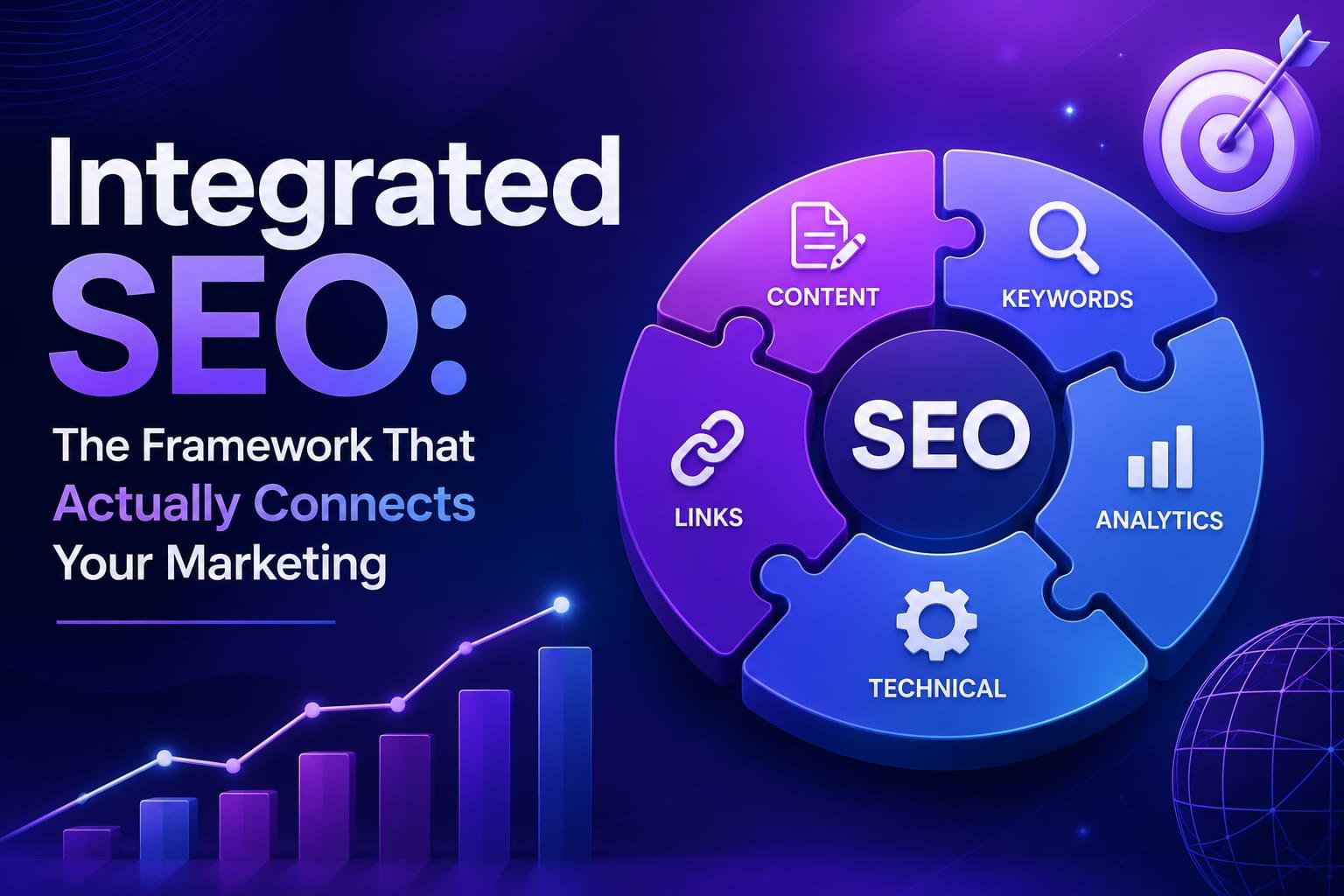
Integrated SEO is the practice of connecting your technical site health, your content, your local presence, and your AI-search visibility so they support each other instead of working in isolation. Most businesses run SEO as one disconnected task on a list, next to ads and social. That’s the exact gap this guide fixes.
If you’ve landed here searching “SEO was ist das” or wondering what integrated SEO even is, you’re in the right place — the short answer above is the whole idea, and everything below shows you how to actually build it.
And if autocomplete nudged you toward “integrated season” instead of integrated SEO, that’s a common typo for the same search — you’re still in the right place.
What Is Integrated SEO?
Integrated SEO is SEO work that’s deliberately connected to your content, your paid ads, your local listings, and your site’s technical foundation, so a fix in one area strengthens the others. A site can rank for a keyword and still lose the visit if the page is slow, the content doesn’t match what a Google AI Overview wants to cite, or the business listing is wrong.
Think of it like a car engine, not a single dial. Turning one knob (say, adding blog posts) does nothing if the technical “engine” underneath — crawlability, page speed, structured data — can’t deliver those posts to Google or to an AI answer engine in the first place.
The 4 Types of SEO You Have to Integrate
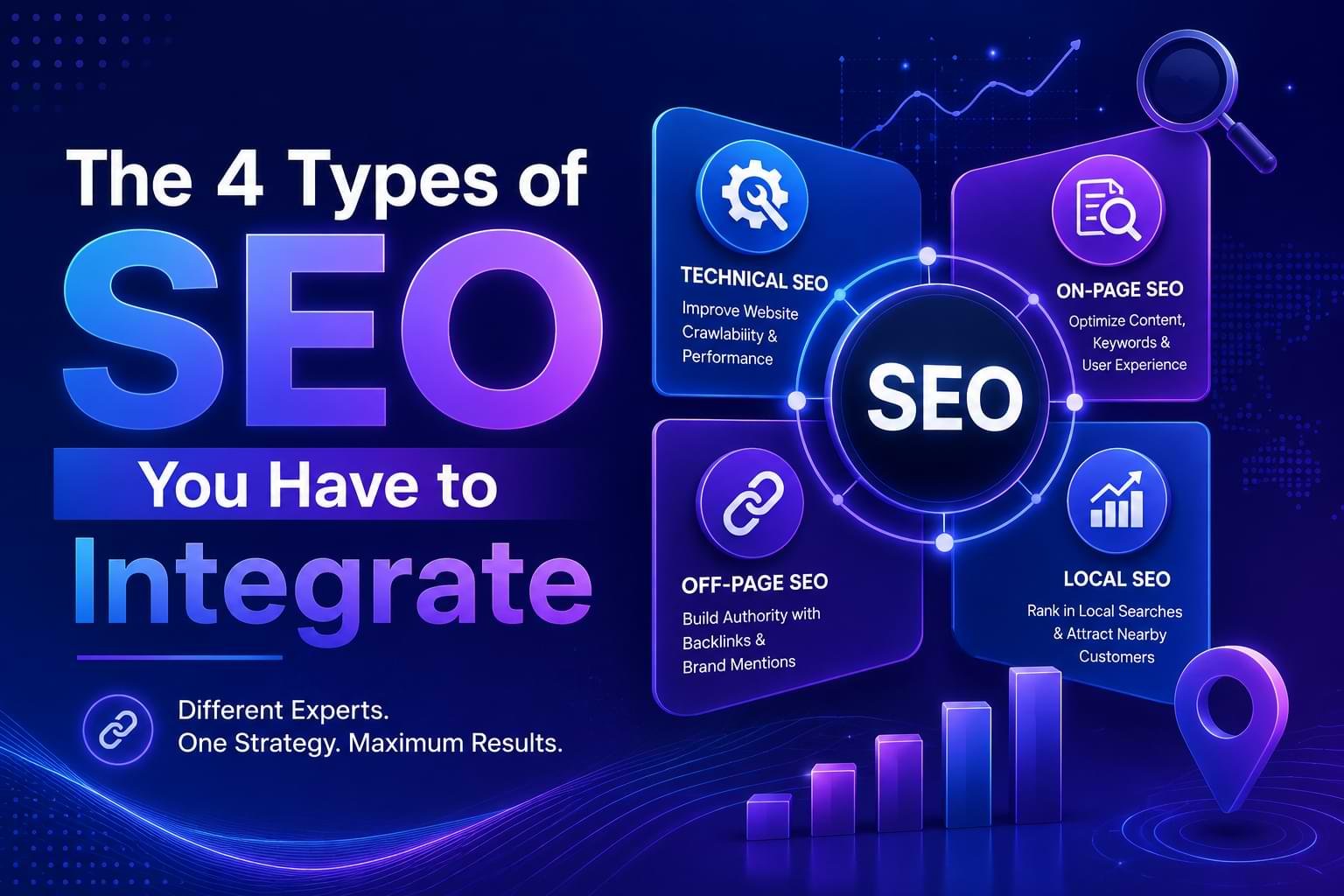
Most guides list SEO tactics. Fewer explain that integrated SEO only works if you’re actually managing four distinct types at once.
- Technical SEO is the work that makes sure Google and AI crawlers like GPTBot, PerplexityBot, and ClaudeBot can access, render, and understand your site. This includes page speed, mobile rendering, clean URL structure, and correct robots.txt rules.
- On-page SEO is how you structure and write the content itself — headings, keyword placement, internal links, and clear answers. A well-optimized page answers the reader’s question in the first few sentences, then supports that answer with detail.
- Off-page SEO is what happens outside your site: backlinks, brand mentions, and citations that tell Google and AI systems other sources trust you. This is slower to build than the other three, but it’s the signal that’s hardest for a competitor to copy.
- Local SEO is the work that gets a business found for “near me” and map-pack searches — your Google Business Profile, local citations, and location-specific content. For a Miami business, this also means managing listings and reviews in both English and Spanish.
An integrated SEO framework treats these four as one system instead of four separate to-do lists. A client can write excellent content (on-page), but if GPTBot is blocked in robots.txt (technical), that content never reaches an AI Overview no matter how well it’s written.
Or a business can rank well organically (technical + on-page) but still lose local customers if its Google Business Profile hours are wrong (local) — the four types have to be checked together, not one at a time.
What Does “SEO Integration” Actually Mean?
SEO integration means the handoff between departments and tactics is deliberate, not accidental. It’s the difference between a content team writing blog posts and a PPC team running ads on totally different keywords, versus both teams sharing the same conversion data.
The primary goal of integrating content marketing with SEO is simple: make sure the content you publish is built around what’s proven to convert, not just what has search volume. Your ad data already tells you which phrases turn into leads — content should be built around that same evidence, not a separate keyword list.
An integrated sales system plays into this too. When your CRM feeds closed-deal data back into your content calendar, your team stops guessing which topics are worth writing about at all — the deals you’ve already closed tell you exactly what to write next.
In practice, SEO integration meaning shows up as a workflow change, not a strategy document. It’s a monthly meeting where the person running ads and the person writing blog posts look at the same conversion report together, instead of each working from their own separate list of keywords.
SEO vs. PPC vs. Content: Why Running Them Separately Fails?
SEO builds compounding, long-term organic visibility. PPC buys immediate visibility you pay for every click. Content marketing is the material that fuels both — the pages SEO ranks and the landing pages PPC sends traffic to.
Run them separately and you get waste: PPC pays to test a headline that SEO never reuses, or content gets written for keywords nobody actually searches for or converts on. Run them together and PPC becomes a live testing lab for the exact page titles and meta descriptions your organic pages should use.
A simple rule: if a paid ad’s headline consistently beats another in click-through rate, that’s the headline your organic title tag and H1 should adopt next. That’s what an integrated SEO approach looks like in practice — not three departments, one shared decision.
This matters even more when a business is deciding where to put its next dollar. A site with strong technical SEO and thin content should spend that dollar on writing. A site with great content but slow load times should spend it on a developer, not another blog post.
Integrated SEO services exist specifically to make that call correctly, because an agency that only sells content will always recommend content, and one that only sells ads will always recommend ads.
The 6-Step Integrated SEO Audit Egochi Runs
This is the actual audit sequence used on client sites, not a generic checklist. Muhammad Rehan Iqbal, Co-Founder and Content Strategy & Web Development Lead at Egochi Miami SEO Agency, leads this process personally on YMYL and local-service client sites, where a mistake in a claim or a broken schema tag carries real business risk.
- Crawl the site with Screaming Frog to find blocked pages, broken links, and duplicate content before touching a single keyword.
- Check Google Search Console’s Generative AI performance report (expanded in June 2026) to see whether pages are already appearing in AI Overviews, and for which queries.
- Audit robots.txt and server logs to confirm GPTBot, PerplexityBot, and ClaudeBot can actually reach and fetch key pages — a step almost every generic SEO checklist skips.
- Validate structured data using Google’s Rich Results Test, focused on LocalBusiness, Organization, and Article schema.
- Match content to proven PPC and CRM keyword data so new pages target terms that already convert, not just terms with volume.
- Set a 90-day remeasurement point using Search Console and GA4 to confirm the fixes moved both traditional rankings and AI citation rates.
On one recent client audit, Step 3 caught a robots.txt rule silently blocking AI crawlers from the blog subdirectory — the technical kind of gap that never shows up in a content-only review. [CLIENT NUMBER TO VERIFY: confirm the exact before/after AI-citation change once the client case file is finalized.]
Each step feeds the next one directly. The crawl in Step 1 tells you which pages are even worth auditing further; the Search Console review in Step 2 tells you which of those pages are already close to an AI citation and just need a small push; the crawler-access check in Step 3 tells you whether that push will even reach the AI systems in the first place.
Skipping straight to Step 5 — matching content to keyword data — without confirming Steps 1 through 3 is the single most common mistake in a rushed integrated SEO audit, because it optimizes writing for pages that technically can’t be seen yet.
AI Integrated SEO: Where AEO and GEO Fit?
SEO isn’t being replaced by AI — it’s being extended by it. Answer Engine Optimization (AEO) and Generative Engine Optimization (GEO) are the practices of structuring content so AI tools like Google’s AI Mode, ChatGPT, and Perplexity can extract and cite it directly.
AI integrated SEO means the same page satisfies three readers at once: a human scanning for an answer, Google’s traditional crawler, and an AI system deciding whether to quote you. That happens through short, complete answers under each heading, clear definitions, and named sources — not through separate “AI content” written on the side.
The reader asking “is SEO replaced by AI” usually means “should I stop investing in SEO.” The honest answer: no — AI answer engines still pull from indexed, well-structured, crawlable content, so the technical and on-page SEO fundamentals matter more, not less.
Here’s the counterintuitive part: sites that treat AI integrated SEO as a separate project, with its own “AI content” written on the side, usually perform worse than sites that just improve their existing pages. Google’s AI Overviews and AI Mode pull from the same index your traditional rankings come from — there’s no separate database to optimize for.
The work is the same work, done more precisely: clearer definitions, shorter paragraphs, and named sources instead of vague claims.
Is SEO an IT Skill or a Marketing Skill?
SEO is both, and treating it as only one or the other is a common reason integration fails. The marketing side covers keyword research, content, and messaging. The IT side covers server response times, crawl budget, redirects, and structured data — work that usually needs a developer, not just a writer.
This is also where a site’s web development lead earns their place. Egochi’s own SEO-first development work exists specifically because technical fixes (page speed, schema, crawler access) sit on the IT side of that line, while the content strategy sits on the marketing side.
Why Local + Bilingual Integration Matters in Miami?
A generic integrated SEO strategy built for a national SaaS brand doesn’t automatically work for a Miami-based business competing in a bilingual market. Local SEO here means integrating Spanish-language search behavior, not just translating an English page.
Someone searching in Spanish for a service and someone searching in English for the same service often use different phrasing entirely, and Google treats those as separate intent signals.
An integrated SEO framework for a Miami business has to plan content in both languages from the start, with each language’s on-page and local SEO handled as its own thread, not an afterthought bolted onto the English site.
This is also where hreflang tags, separate meta descriptions per language, and language-specific review responses come in — three details that most national integrated SEO services skip because they’re built for single-language markets.
Skipping them doesn’t just lose Spanish-speaking traffic; it tells Google the two versions of a page are duplicates of each other instead of distinct, valid answers for two different audiences.
Read more on our Local SEO Miami page for how that bilingual layer works in practice, and see our AI Search Optimization page for how the AEO/GEO layer above applies specifically to local, multilingual businesses.
How to Measure an Integrated SEO Strategy?
Track four things together, not in separate reports: organic rankings, AI Overview/AI Mode citation appearances (via Search Console’s Generative AI report), Google Business Profile visibility for local terms, and conversion rate by keyword source pulled from your CRM.
If rankings improve but conversions from those keywords don’t, the integration isn’t finished — the content, not the ranking, is the problem.
Set a quarterly review, not a set-and-forget one. An integrated SEO services engagement should report on all four metrics together, because a win in one and a loss in another usually means one part of the system — technical, content, local, or AI-search — is still working alone.
A practical starting cadence: check Search Console weekly for AI citation and ranking movement, review CRM conversion-by-keyword data monthly, and hold a full quarterly review where all four metrics sit on one page instead of four separate reports from four separate tools.
That single-page habit is usually what separates a business that can point to real integration from one that’s just running SEO, PPC, and content marketing next to each other and calling it a strategy.
For a broader look at how this fits into a full SEO program, see our SEO services overview.
FAQs
What are the 4 types of SEO?
The 4 types of SEO are technical SEO (crawlability and site health), on-page SEO (content and structure), off-page SEO (backlinks and mentions), and local SEO (map-pack and “near me” visibility). Integrated SEO manages all four as one connected system.
What is SEO integration?
SEO integration is the deliberate coordination of SEO with content marketing, paid ads, and CRM data, so each channel’s evidence — like which keywords convert — shapes decisions in the others instead of each team working from a separate keyword list.
Is SEO replaced by AI?
No. AI Overviews, AI Mode, and tools like ChatGPT and Perplexity still depend on indexed, well-structured, crawlable content to generate answers, so SEO fundamentals remain the foundation AI search is built on top of.
Is SEO an IT skill?
SEO is part IT and part marketing. Technical elements like crawl access, page speed, redirects, and structured data are IT-side work, while keyword strategy and content are marketing-side work — an integrated SEO framework needs both.
What is the primary goal of integrating content marketing with SEO?
The primary goal is making sure the content you publish targets keywords already proven to convert — using PPC and CRM data as evidence — rather than targeting keywords chosen for search volume alone.
What is an integrated SEO framework?
An integrated SEO framework is a repeatable process — like the 6-step audit above — that manages technical, content, local, and AI-search SEO together, with shared data instead of separate department silos.
How is an integrated SEO strategy different from regular SEO?
Regular SEO often optimizes pages in isolation. An integrated SEO strategy connects those same pages to PPC data, CRM conversion data, local listings, and AI-crawler access, so improvements in one area reinforce the others.
Do I need integrated SEO services if I already run ads?
Yes — running ads without integrating that data into your organic content means paying twice to learn what already works once. Integrated SEO services use your existing ad performance to guide organic content decisions instead of duplicating the research.