Quick Answer:
When you search for land for sale near me, use a dedicated land search platform (LandSearch, LandWatch, Land.com, or Zillow’s land filter) rather than a general home-search app, since general portals often bury vacant-lot listings under home results. Once you find a parcel nearby, verify zoning, road access, utility availability, and title before making an offer.
Budget for a larger down payment than a home purchase — raw land typically requires 20–50% down, and land loan interest rates in 2026 run roughly 1–3 percentage points above standard mortgage rates. Confirm these numbers with a local lender before you get attached to a specific parcel.
If you’re typing “land for sale near me” into Google, you’re probably one of two people: someone who wants to build a home, or someone looking at land as an investment or recreational property. Either way, the search itself is the easy part. Knowing what to do once you find a parcel is where most first-time buyers get stuck.
How to Actually Search for Land Near You?
A general real estate app is built around houses, so vacant land often gets buried or mislabeled. Use a search platform built specifically for land:
- LandSearch, LandWatch, and Land.com — dedicated land inventory with acreage, price-per-acre, and mapping filters
- Zillow and Redfin’s “Land” property-type filter — useful if you’re already comparing homes and lots in the same area
- County assessor and GIS parcel maps — free, official, and the most accurate source for boundaries, zoning, and ownership before you even contact an agent
- A local land or rural-property agent — many parcels, especially rural acreage, never get listed on national portals at all
Set your radius wide the first time you search. Land inventory near urban centers is thinner and pricier than most home searches, so a search that returns nothing in a 5-mile radius often returns dozens of options at 20–30 miles.
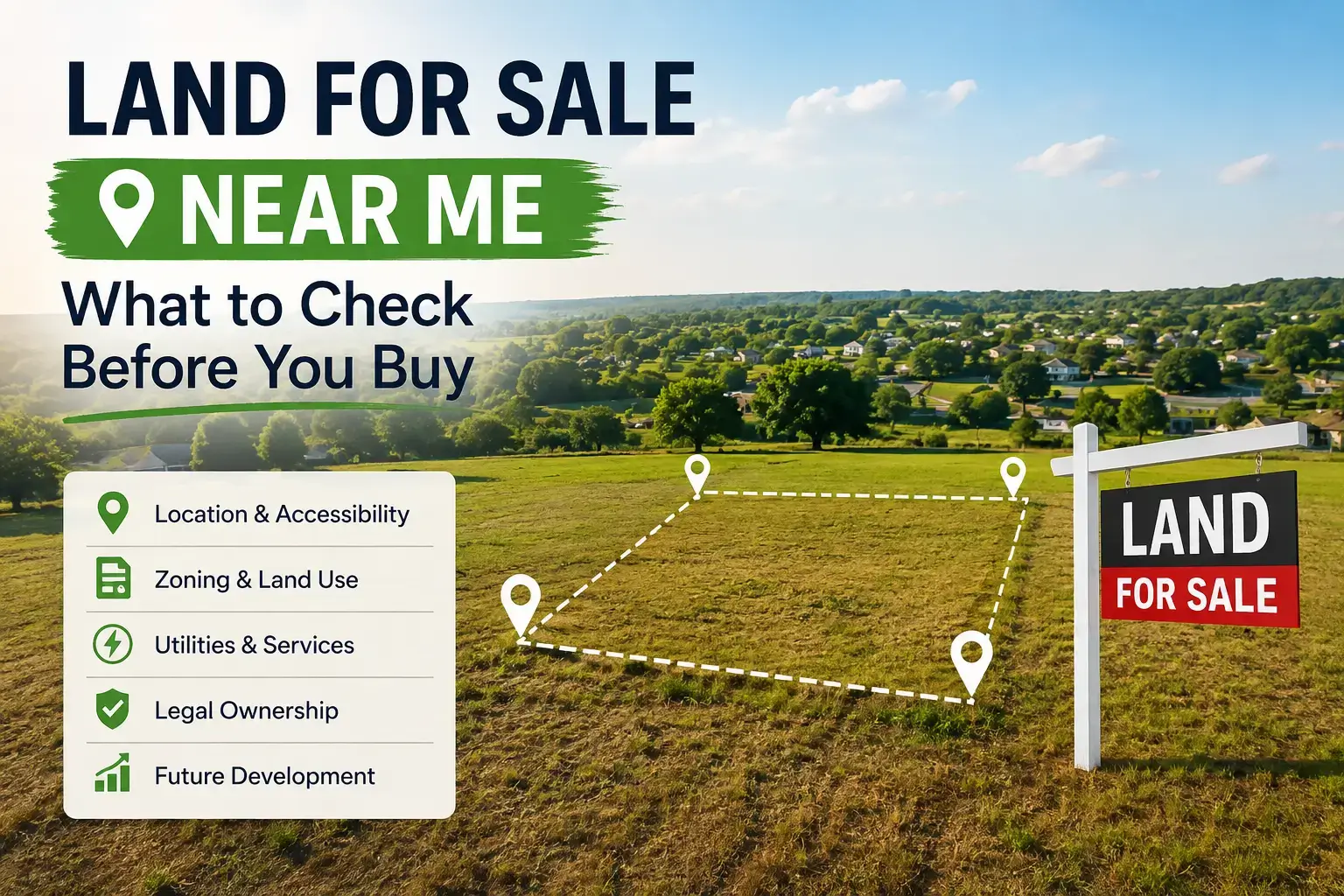
What to Check Before You Buy Land?
Every reputable due-diligence guide agrees on the same core categories — the difference is in how much depth a first-time buyer actually needs. Here’s the condensed version:
- Zoning and permitted use. Confirm with the local planning or zoning office that the land allows what you intend to do with it — residential, agricultural, commercial, or recreational. A parcel zoned for one use can be effectively worthless for another.
- Access. Does the parcel have legal, recorded road access, or does it rely on an easement across someone else’s property? Landlocked parcels are common and can be difficult or impossible to build on.
- Utilities. Is the land already connected to water, sewer/septic capacity, and electricity, or will you need to install a well, septic system, and run power lines? This single factor can add tens of thousands of dollars to your real cost.
- Title and survey. Order a title search to confirm clear ownership and check for liens, and get a professional survey so the boundaries you’re buying match what’s actually on the ground.
- Environmental and flood risk. Check FEMA flood maps and ask about soil quality, wetlands designations, or contamination history, especially on land that was previously used for industrial or agricultural purposes.
- Property taxes and HOA/deed restrictions. Confirm the current tax bill and check whether any covenants restrict building size, livestock, or future subdivision.
Land Types and Financing Compared
Not all “land for sale near me” results are the same kind of purchase. The type of land you’re looking at directly changes how hard it is to finance.
| Land Type | Typical Down Payment | Typical Interest Rate | What It Means for You |
|---|---|---|---|
| Raw land (no utilities, no road access) | 30–50% | 8–10% | Hardest to finance; most lenders want a detailed development plan before approving |
| Unimproved land (some access, no utilities) | 20–35% | 6.5–9% | Moderate risk; local banks and credit unions are often more flexible than national lenders |
| Improved land (utilities and road access in place) | 15–20% | 6.5–8% | Closest to a standard mortgage in terms of approval difficulty and rate |
Because land produces no income and is harder for a lender to resell than a house, land loans carry meaningfully higher down payments and rates than home mortgages. If traditional financing is too restrictive for the parcel you want, seller financing is common in the land market — terms of 10–30% down with 5–9% interest over 5–20 years cover most seller-financed rural deals.
Explore financing details further in our land financing and loan comparison guide before you make an offer.
What Land Actually Costs Near You?
Land pricing is hyper-local — a national average tells you almost nothing useful. Recent county-level land market data illustrates just how wide that range is: rural land in parts of Washington State has sold for a median of roughly $3,875 per acre, while comparable rural parcels in coastal North Carolina have sold for a median of over $119,000 per acre.
Suburban and urban lots under one acre follow the same pattern of extreme local variation, running anywhere from under $10,000 to well over $400,000 depending on the county. Rural land prices nationally are projected to hold roughly flat to up 3% through 2026, with premium, utility-ready, and multi-use parcels outperforming remote or single-use tracts.
Because of this spread, always compare your target parcel against recent local sales, not a national average, before deciding whether the asking price is reasonable.
Common Mistakes First-Time Land Buyers Make
- Assuming “for sale” means “buildable.” Zoning, access, and utility gaps can make a listed parcel unbuildable without significant investment.
- Skipping the survey. Fence lines and listing photos are not legal boundaries — only a survey is.
- Underestimating financing costs. Buyers who budget like they’re buying a house are consistently surprised by land’s larger down payment requirements.
- Not checking easements. A neighbor’s legal right to cross your land, or a utility company’s right to run lines through it, can limit what you can build and where.
- Searching too narrow a radius. Land inventory is thinner than home inventory; widening your search radius often surfaces significantly more options.
Key Takeaways
- Use a dedicated land-search platform, not a general home-search app, to find land for sale near you.
- Always verify zoning, access, utilities, title, and environmental risk before making an offer.
- Land loans require larger down payments (20–50%) and higher rates (roughly 1–3 points above mortgage rates) than home financing.
- Land pricing is hyper-local — compare against recent sales in the specific county, not a national average.
- Widen your search radius if nearby inventory looks thin; land listings are sparser than home listings.
For a full walkthrough of every due-diligence step in order, see our complete land buying checklist, and if you’re weighing raw versus improved land for a specific project, our raw land vs. improved land comparison breaks down the trade-offs in more detail.
FAQs
Is land for sale near me always buildable?
No. A parcel being actively listed doesn’t guarantee it’s buildable — zoning restrictions, lack of road access, or missing utility infrastructure can all prevent construction. Always confirm buildability with the local zoning office before assuming a listed parcel matches your plans.
Is buying land still worth it in 2026?
For buyers with a clear purpose — building, farming, or long-term holding — land remains a reasonable investment in 2026, with rural land prices projected to hold roughly flat to modestly higher through the year, though premium and utility-ready parcels are outperforming remote, single-use tracts. It’s a weaker option for buyers hoping for fast appreciation, since land is far less liquid than a home and financing costs are higher.
How is buying land different from buying a house?
Land purchases typically require a much larger down payment (20–50% versus 3–20% for a home) and higher interest rates, since lenders view land as riskier collateral with no structure to fall back on if you default. Land also usually closes faster, since there’s no home inspection process, but the due-diligence work (zoning, survey, access, utilities) is more extensive than a typical home purchase.
How much does land near me actually cost?
It depends almost entirely on your specific county — recent data shows rural land selling for under $4,000 per acre in some counties and well over $100,000 per acre in others. Always pull recent comparable sales for your specific area rather than relying on a national average.
Why can’t I find any land listings near me?
Land inventory is significantly thinner than home inventory in most areas, especially close to urban centers, so a narrow search radius often returns few or no results. Try a dedicated land-search platform and widen your radius to 20–30 miles before assuming nothing is available.
What’s the real difference between raw, unimproved, and improved land?
Raw land has no utilities or road access and is the hardest and most expensive to finance; unimproved land has partial access or utilities; improved land already has utilities and road frontage in place, making it the closest to a standard home-financing experience. The type of land directly determines your down payment, interest rate, and how quickly you could realistically build.
Do I need a real estate agent to buy land, or can I do it myself?
You can search and negotiate land purchases without an agent, but many rural parcels — especially larger acreage — never appear on national listing portals and are only available through local land agents or direct owner contact. An agent who specializes in land (not homes) also tends to know local zoning quirks and access issues that don’t show up in a listing description.