Quick Answer:
Posicionamiento web — Spanish for “web positioning,” the term most Miami business owners actually type into Google — is the process of optimizing a website so it shows up in Google’s top results when local customers search for what you offer. It combines technical SEO, bilingual content in English and Spanish, an optimized Google Business Profile (GBP), and relevant local links. Measurable results typically take 3 to 6 months.
This guide is written for small and mid-sized business owners in Miami-Dade, marketing managers, and anyone deciding whether hiring a web positioning agency is worth it.
What “posicionamiento web” actually means?
SEO (Search Engine Optimization) is the umbrella term: the set of techniques that improve a site’s organic — meaning unpaid — visibility on search engines like Google. It differs from paid advertising (Google Ads) in that you’re not paying per click; you’re investing in a site that earns its ranking through relevance, authority, and user experience.
In Miami’s case, web positioning has an extra layer most agencies skip: the city doesn’t search in one uniform way. It blends English and Spanish queries, sharply different neighborhood search patterns (Brickell doesn’t search the way Hialeah or Little Havana does), and a majority-Hispanic population that researches local businesses in Spanish before deciding where to buy.
Why Miami is a distinct SEO market?
Miami-Dade isn’t a generic U.S. market, and treating it like one is the first mistake many agencies make.
- Miami-Dade County has an estimated population of roughly 2.74 million, of whom 69.3% identify as Hispanic or Latino — nearly triple Florida’s statewide average of 27.4%, according to U.S. Census Bureau estimates (American Community Survey 2020–2024).
- Within the City of Miami specifically, the Hispanic share reaches 70.2%, per the U.S. Census Bureau.
- Median household income in Miami-Dade was $71,753 in 2024, according to Census data compiled by Florida Demographics.
What does this mean for web positioning?
A site optimized only in English, with no Spanish-language content, no neighborhood-specific service pages (Brickell, Doral, Hialeah, Coral Gables, Little Havana), and a Google Business Profile that isn’t built for bilingual search, is excluding the majority of the local market — not a minority of it.
How Google’s local search algorithm actually works?
Google doesn’t rank “near me” and Local Pack (map) results with the same algorithm it uses for generic web results. For local-intent searches, it prioritizes three factors Google itself documents: relevance (how well a business profile matches the search), distance (how close the business is to the searcher), and prominence (how well-known and well-reviewed the business is, both offline and online).
Mike Blumenthal, a local-search analyst at Near Media and co-founder of GatherUp — one of the most cited experts in the local SEO industry — argues the focus should shift away from trying to directly manipulate the algorithm and instead “shift effort into local brand building.” In practice: genuine reviews, local press coverage, and real community recognition carry more weight than isolated technical tricks.
This shows up in the data too: according to a Near Media interview, Google Business Profile drives between 40% and 90% of “last-touch” leads in local search, depending on the industry — which makes a poorly optimized Google profile one of the most common, and least visible, sources of lost customers for a Miami business.
Spanish-language SEO:The advantage most agencies ignore
With nearly 7 in 10 Miami-Dade residents identifying as Hispanic, English-only content is failing to serve the majority of the market. This isn’t just a translation issue — it means creating content written natively in Spanish, using the actual vocabulary and phrasing Hispanic users search with (“agencia de posicionamiento web en Miami” rather than a literal translation of “SEO agency near me”).
For businesses serving neighborhoods like Hialeah, Doral, or Little Havana, that also means: service pages with specific neighborhood mentions, geo-targeted Google Business Profile posts, and a review strategy that actively collects Spanish-language reviews — not just English ones.
Why Traditional SEO alone isn’t enough anymore: zero-click and AI Overviews?
In 2026, ranking #1 on Google no longer guarantees traffic the way it used to. According to Similarweb’s Zero-Click Search Study (in partnership with SparkToro, 2025), roughly 58.5% of Google searches in the U.S. end without the user clicking any result — the user gets the answer directly on the results page.
Layered on top of that is the growth of AI Overviews (AI-generated summaries Google places at the top of results). A Seer Interactive study of 25.1 million organic impressions found that organic click-through rate drops significantly when an AI Overview appears on a search.
What does this mean for a Miami business?
The goal is no longer just “rank on page 1” — it’s becoming the source Google and AI systems cite directly as the answer, which the industry calls GEO (Generative Engine Optimization) and AEO (Answer Engine Optimization). That’s earned through well-structured content, verifiable data, real authorship, and schema markup — exactly the elements missing from every competitor reviewed in this guide.
The components of a real Web positioning strategy in Miami
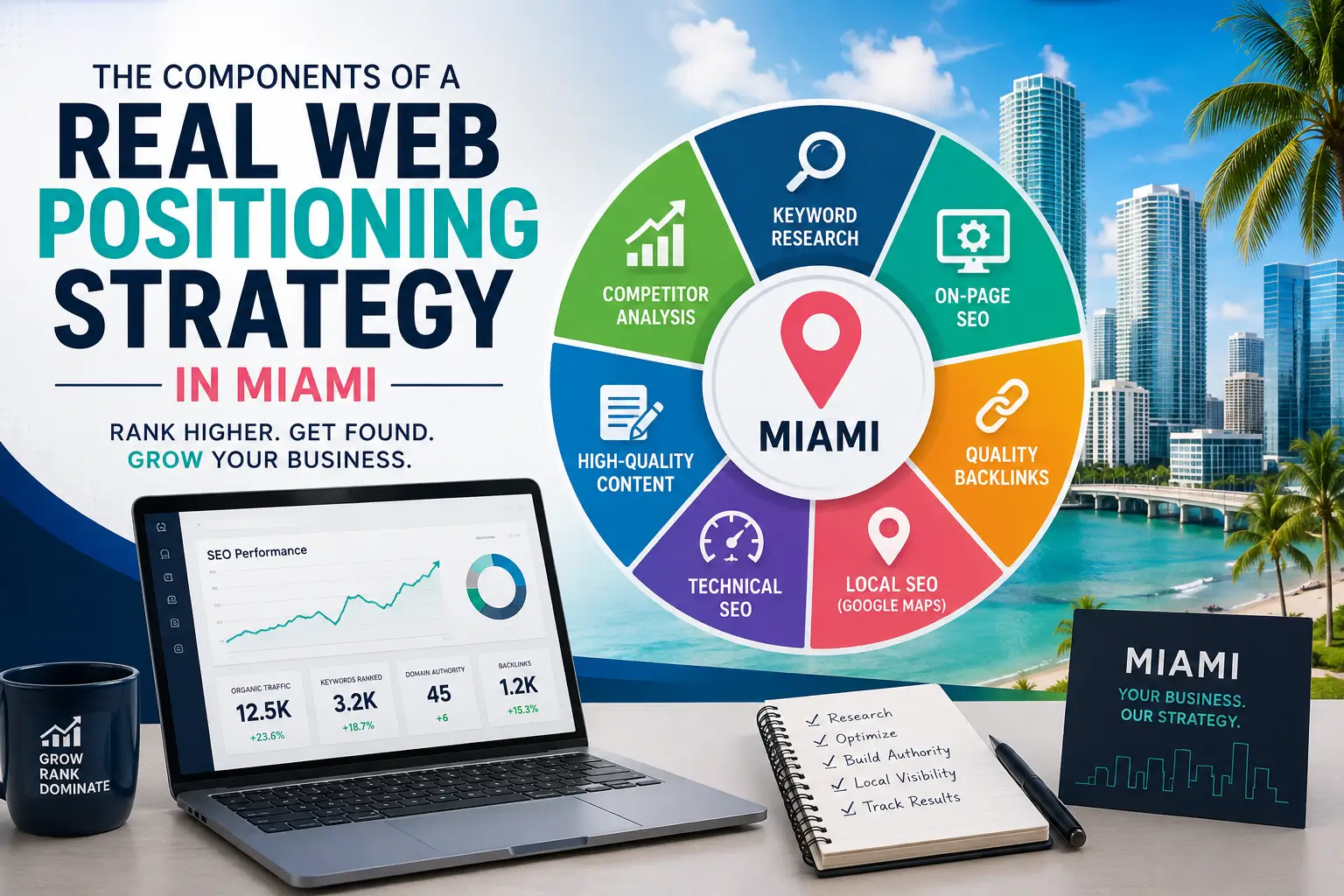
A complete strategy combines several layers that need to work together, not in isolation:
- Technical SEO: page speed, correct indexing, site structure, Core Web Vitals, and mobile performance (most local searches happen on a phone).
- On-page SEO: content that directly answers search intent, clear headings, and keywords used naturally rather than forced.
- Google Business Profile: correct category, up-to-date hours, real photos, regular posts, and active review management.
- Bilingual local content: service pages by zone/neighborhood, in both English and Spanish.
- Authority (local link building): mentions and links from Miami directories, local media, and local associations — not bulk-purchased generic links.
- Reviews and reputation: consistently requesting reviews and responding to all of them, positive and negative.
What it costs and how long it takes?
Cost varies by industry competitiveness, the site’s current state, and project scope (technical SEO, content, link building, or all three). What’s consistent across serious agencies is the timeline: measurable organic results — more traffic, better rankings, more leads — typically start showing between 3 and 6 months in, because Google needs time to recrawl, evaluate, and re-index the changes.
Any agency promising the #1 spot on Google within days or weeks is making a promise that isn’t technically achievable on a sustainable basis.
Common mistakes costing Miami businesses customers:
- Running the site in English only, in a market that’s majority Spanish-speaking.
- Letting the Google Business Profile go stale (outdated hours, photos, wrong category).
- Ignoring negative reviews instead of responding to them.
- Buying bulk low-quality links instead of building real local authority.
- Optimizing only for “Miami” broadly instead of neighborhood-specific content.
- Not adapting strategy to the fact that a large share of searches now end without a click (zero-click).
How to choose a web positioning agency in Miami?
Before hiring, it’s worth checking:
- Is there an identifiable author or team with real, verifiable credentials?
- Can they show actual work examples, not just generic promises?
- Do they work natively in Spanish, not just translated content?
- Do they set realistic timelines (3–6 months) instead of promising instant results?
- Do they have a specific strategy for Google Business Profile and reviews, not just the website?
Key Takeaways
- Web positioning in Miami requires a bilingual strategy: nearly 70% of Miami-Dade’s population is Hispanic (U.S. Census Bureau).
- Google Business Profile can drive between 40% and 90% of local leads, per data cited by Near Media.
- Organic SEO results typically take 3 to 6 months to become measurable.
- 58.5% of U.S. Google searches now end without a click (Similarweb/SparkToro, 2025), which makes optimizing for AI (GEO/AEO) as important as optimizing for traditional ranking.
- Building real local brand presence (reviews, local press, relationships) outweighs isolated technical tricks, according to local SEO expert Mike Blumenthal.
FAQs
What does “posicionamiento web” actually mean?
It’s the Spanish term for web positioning, or SEO: the process of optimizing a website so it ranks organically (unpaid) in top search results on engines like Google. It includes technical SEO, content, authority, and user experience.
Is web positioning still worth it in 2026, with so much AI in search?
Yes, but its shape has changed. Even though 58.5% of U.S. searches end without a click (Similarweb, 2025), businesses that appear as a cited source in Google and in AI answers still capture the highest-intent demand. SEO now works alongside GEO/AEO rather than being replaced by it.
How is web positioning (SEO) different from Google Ads?
SEO builds sustainable organic visibility over the medium term without paying per click; Google Ads buys immediate visibility for as long as the campaign runs. Many Miami businesses combine both: Ads for quick results, SEO for sustained growth.
How much does web positioning in Miami cost, and how long until I see results?
Cost depends on the industry, competition, and project scope. The timeline is more predictable: 3 to 6 months for measurable movement, since Google needs time to crawl and index the changes.
Why does Spanish-language SEO matter so specifically in Miami?
Because roughly 69–70% of Miami-Dade’s population identifies as Hispanic (U.S. Census Bureau), and a meaningful share of those searches happen directly in Spanish, not in translated English.
How much does Google Business Profile matter compared to the website itself in local SEO?
More than most businesses assume: per data cited by Near Media analysts, Google Business Profile can drive between 40% and 90% of last-touch leads in local search, depending on the industry.