Quick Answer:
A local SEO company in Bonaire helps island businesses — dive shops, hotels, restaurants, and tour operators — show up in Google’s Local 3-Pack and Maps results when travelers and residents search nearby. Because 46% of all Google searches carry local intent and 76% of near-me searches lead to a visit within 24 hours, ranking locally directly drives walk-ins, bookings, and calls.
On Bonaire specifically, this means optimizing a Google Business Profile in both English and Dutch, building citations across regional and Dutch Caribbean directories, earning reviews from a mostly TripAdvisor–driven dive-tourism audience, and targeting bilingual keywords tied to Kralendijk and the island’s tourism economy. The right agency should show measurable Map Pack results, not generic SEO promises copied from a template built for another city entirely.
Key takeaway:
On Bonaire, local SEO wins are decided by Google Business Profile completeness, review volume in English and Dutch, and citation consistency — not by generic keyword tricks.
Which Bonaire Are We Talking About?
“Bonaire” refers to two different places online, and most agencies ranking for this term don’t clarify which one they mean. Bonaire in this article is the Dutch Caribbean island — part of the Caribbean Netherlands, alongside Sint Eustatius and Saba, often called one of the “ABC islands” with Aruba and Curaçao. Its capital is Kralendijk.
There is also a Bonaire, Georgia, a small US town near Warner Robins — several SEO agencies target that market under the same keyword, which is why searches for “SEO company Bonaire” surface irrelevant US small-town marketing pages. If your business operates on the Caribbean island, confirm any agency you’re evaluating actually understands that market — not the Georgia one.
Why Local SEO Matters More for a Small Island Economy?
Bonaire’s economy is heavily tourism-dependent: tourism represents roughly 38.4% of the island’s economy according to the Chamber of Commerce Bonaire’s economic data, and the island’s business registrations have been growing at an average of 2.8% annually. Dive tourism, hotels, and dining anchor most of that activity, with the Netherlands and the United States supplying the large majority of stayover visitors according to Tourism Corporation Bonaire’s monthly arrival reports.
That visitor base searches the way any modern traveler does — on a phone, right before deciding where to eat, dive, or book a tour. Nationally, local-intent behavior has become the dominant form of search:
- 46% of all Google searches now carry local intent, up from roughly 30% in 2019.
- 76% of people who perform a “near me” search visit a business within 24 hours.
- A complete Google Business Profile generates roughly 7x more clicks than an incomplete one.
- 97–98% of consumers read online reviews before choosing a local business.
For a Bonaire dive shop or restaurant competing for a visitor who’s on the island for a week and deciding in real time, that 24-hour conversion window is the whole game. A generic, template-driven SEO approach — the kind most agencies ranking for this keyword are actually selling — misses the bilingual, tourism-specific, review-heavy reality of how people actually choose a business on the island.
What a Local SEO Company in Bonaire Should Actually Do?
- Optimize and verify your Google Business Profile in both English and Dutch, since Dutch visitors make up the largest single source market for the island.
- Build and correct citations across regional Caribbean, Dutch Caribbean, and dive-tourism directories — not generic US directory lists that don’t apply.
- Run a structured review strategy, since consumers now cross-reference multiple platforms (Google, Trip Advisor, dive-specific review sites) before booking, and businesses with fewer than 10 reviews or under a 4.0 rating see a measurable conversion penalty.
- Keep NAP (Name-Address-Phone) data consistent everywhere the business is listed — inconsistent addresses are one of the most common reasons small island businesses fail to rank in the Map Pack.
- Target bilingual, tourism-relevant keywords — English for US and international visitors, Dutch for the island’s largest visitor segment — rather than a single-language keyword list built for a mainland US market.
- Report on Map Pack visibility and review growth, not just generic traffic numbers, since Map Pack placement is what actually drives calls and walk-ins for a location-based business.
DIY vs. Local Agency vs. Remote/International Agency
| Approach | Best For | Strength | Real Limitation |
|---|---|---|---|
| DIY (owner-managed) | Very small, single-location businesses with time to spare | Free, full control, fastest to start | Most owners lack time to keep citations, reviews, and GBP posts current; easy to fall behind competitors |
| Bonaire-based freelancer/agency | Businesses wanting in-person familiarity with the island | Local market knowledge, easy communication | Limited pool of specialists on a small island; may lack deeper technical SEO or multi-market experience |
| Remote agency with Caribbean/tourism experience | Hotels, dive operators, and multi-location or growth-focused businesses | Access to broader technical SEO, content, and bilingual expertise; not limited by island talent pool | Requires an agency that genuinely understands Bonaire’s market, not a city-name-swapped template |
Bottom line:
The deciding factor isn’t physical location — it’s whether the agency, wherever it’s based, actually understands Bonaire’s bilingual, tourism-driven, review-heavy search behavior instead of reapplying a generic playbook.
A Real-World Example
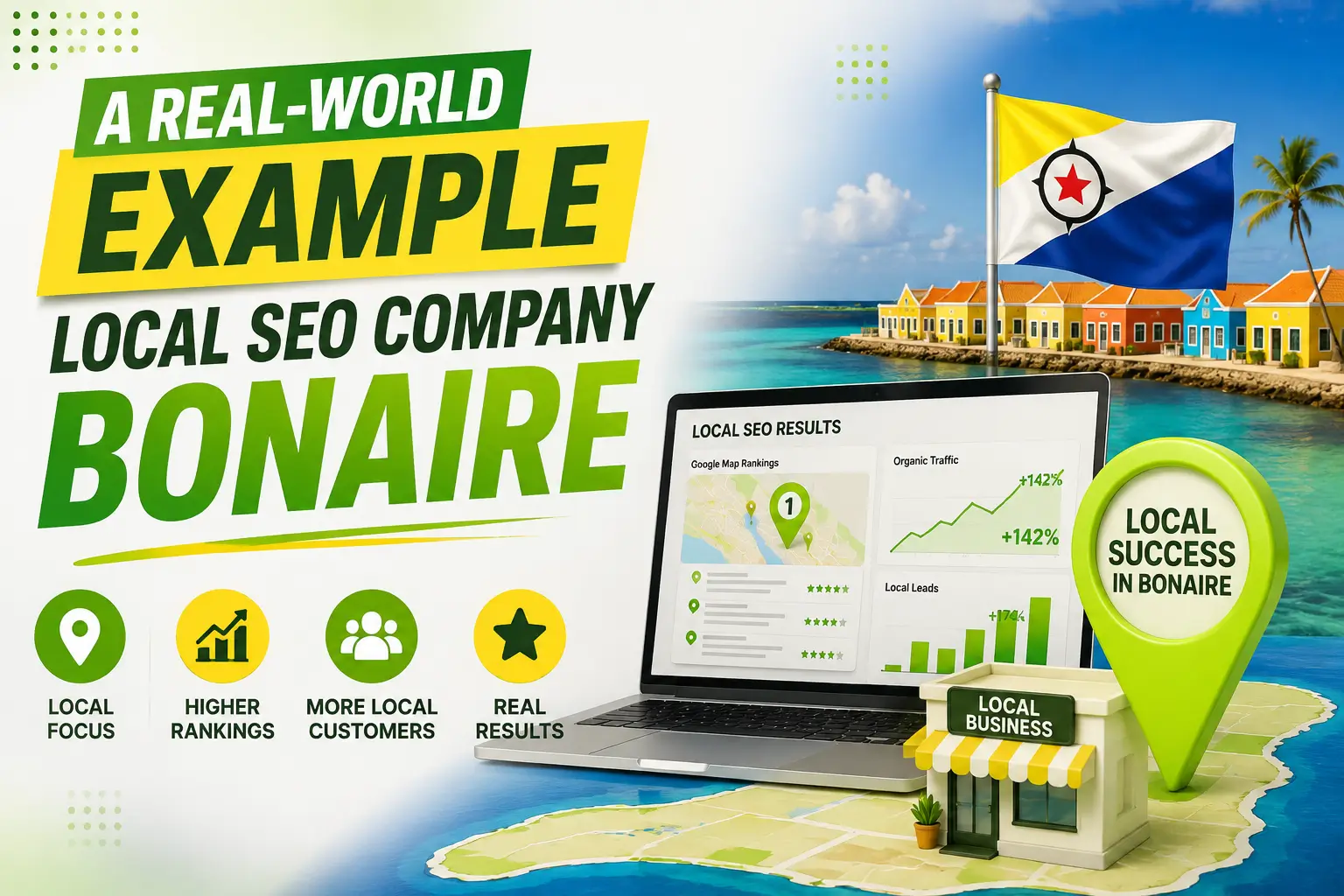
A small Kralendijk-area dive shop with an incomplete Google Business Profile — missing hours, only a handful of reviews, and no Dutch-language description — is functionally invisible to the roughly one in two visitors arriving from the Netherlands who search in Dutch before booking a dive trip.
Completing that profile, adding a Dutch description alongside the English one, and prompting satisfied divers for reviews in both languages is the kind of low-cost, high-impact fix that a template-driven “SEO package” built for a US mainland city will typically skip entirely — because it was never designed with a bilingual tourism market in mind.
What Local SEO Costs?
Based on current market data for small local businesses, single-location local SEO services typically run $40–$80 per month for basic tools and management, while more hands-on multi-channel management for a tourism-facing business (Bonaire hotels and larger dive operators fit this profile) tends to run higher. Treat any quote against what it actually includes — Google Business Profile management, citation building, and review strategy — rather than the price alone.
FAQs
Is “local SEO company in Bonaire” about the Caribbean island or Bonaire, Georgia?
It should mean the Caribbean island — Bonaire, part of the Caribbean Netherlands — but many agencies ranking for this term are actually built around Bonaire, Georgia, a small US town. Confirm which market an agency actually serves before hiring.
Is local SEO still worth it for a small island business in 2026?
Yes. With 46% of all Google searches now carrying local intent and 76% of near-me searches converting to a visit within a day, a business that isn’t optimized for local search is missing nearly half of relevant search volume, regardless of how small the local market is.
How is local SEO on Bonaire different from local SEO in a typical US city?
The visitor base is bilingual (Dutch and English), heavily tourism-driven rather than resident-driven, and concentrated around dive tourism, hotels, and hospitality — so citation sources, review platforms, and keyword targeting all need to reflect that, rather than a template built for a mainland US market.
Should I hire a Bonaire-based agency or a remote one?
Either can work. A Bonaire-based freelancer offers local familiarity, but the island’s small talent pool can limit technical depth. A remote agency with genuine Caribbean/tourism-market experience can offer broader expertise — what matters is whether they understand Bonaire’s actual market, not their physical address.
What’s the single highest-impact first step for a Bonaire business?
Completing the Google Business Profile in both English and Dutch, since incomplete profiles get roughly 7x fewer clicks than complete ones, and Dutch-speaking visitors are the island’s largest source market.
How many reviews does a Bonaire business need to compete in the Map Pack?
There’s no fixed number, but businesses with fewer than 10 reviews or a rating below 4.0 stars see a measurable drop in conversions, and top-ranking Google Business Profiles across markets tend to have well over 100 reviews.