Introduction
Google’s BERT SEO update changed how search engines interpret what you’re actually asking. BERT (Bidirectional Encoder Representations from Transformers) is a natural language processing model that helps Google understand the context and intent behind search queries, not just individual keywords.
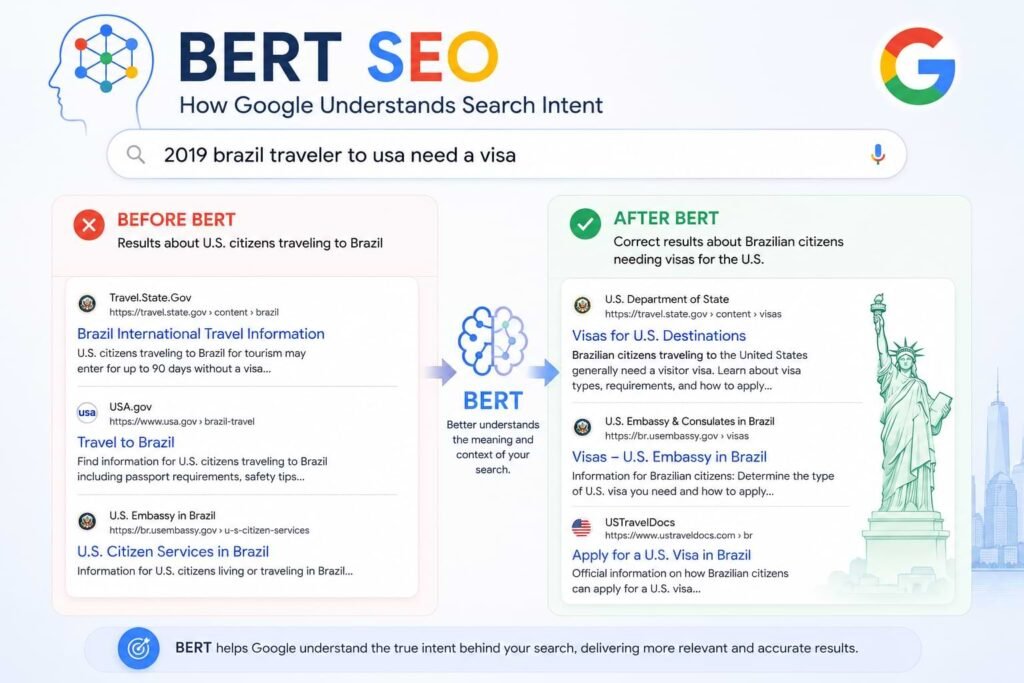
Before BERT, Google struggled with conversational queries and nuanced language. A search for “2019 brazil traveler to usa need a visa” might have ignored the word “to” and returned results about Americans traveling to Brazil—the opposite of what you wanted.
BERT reads queries bidirectionally, analyzing words in relation to all surrounding words rather than one-by-one from left to right. This means Google now understands prepositions, context, and the relationships between words in your search.
For website owners, BERT SEO isn’t about gaming an algorithm. It’s about writing naturally for humans while ensuring your content clearly answers the questions people actually ask.
This article is for website owners, content creators, and SEO professionals who want to understand how BERT affects their search visibility and what they can do to optimize for natural language processing.
What You’ll Learn
- How BERT processes search queries differently than previous Google algorithms and why context matters more than keyword density
- Specific content optimization strategies that align with how BERT interprets natural language and user intent
- Real examples of BERT’s impact on search results and which types of queries see the biggest changes
- Practical steps to audit your content for BERT compatibility without compromising readability or user experience
- How BERT connects to voice search and AI-powered search experiences emerging in 2026
What Is BERT SEO and Why Does It Matter?

BERT SEO refers to optimizing content for Google’s BERT algorithm, which uses natural language processing to understand search queries the way humans naturally communicate. Google rolled out BERT in October 2019, affecting approximately 10% of all English-language queries initially.
BERT stands for Bidirectional Encoder Representations from Transformers. The “bidirectional” part is crucial—it means BERT reads entire sentences in both directions simultaneously, understanding how each word relates to every other word in the query.
Why BERT Changed Everything for Search
Before BERT, Google’s algorithms primarily matched keywords. If your page contained the exact words someone searched for, you had a decent chance of ranking—even if your content didn’t truly answer the question.
BERT shifted the focus from keyword matching to intent matching. Now Google evaluates whether your content genuinely addresses what the searcher needs, based on the full context of their query.
For website owners, this means you can’t rely on keyword stuffing or technical tricks. Your content must provide clear, direct answers to questions people actually ask.
How Does BERT Actually Process Search Queries?
BERT processes queries by analyzing all words in relation to each other, rather than reading left-to-right sequentially. This bidirectional approach lets BERT understand that “bank” means something different in “river bank” versus “savings bank.”
The model uses transformers—a type of neural network architecture that excels at understanding relationships between words regardless of their position in a sentence.
The Technical Process Simplified
When you enter a search query, BERT:
- Tokenizes the query into individual words and sub-word units
- Analyzes each word bidirectionally, looking at all surrounding context simultaneously
- Creates contextual embeddings that represent what each word means in that specific sentence
- Matches the query intent to content that addresses the same contextual meaning
The key innovation is that BERT doesn’t assign fixed meanings to words. The word “apple” gets a different embedding when discussing fruit versus technology, based entirely on surrounding context.
Why Prepositions and Small Words Matter Now
BERT pays attention to function words—prepositions like “to,” “for,” and “from”—that previous algorithms often ignored. These small words frequently determine the entire meaning of a query.
Consider “can you get medicine for someone pharmacy.” Before BERT, Google might have ignored “for” and shown results about picking up your own prescription. BERT understands “for someone” means you’re asking whether you can pick up someone else’s medication—a completely different question with different legal and procedural answers.
What Changed in Search Results After BERT?
Search results became more precise for conversational and long-tail queries after BERT launched. Google reported that one in ten searches showed improved results, particularly for queries with nuanced language or specific contexts.
The biggest improvements appeared in:
- Question-based searches using natural language rather than keyword fragments
- Queries with prepositions that change meaning based on context
- Longer searches where the relationship between words matters
- Searches with implied context that require understanding user intent
Real Examples of BERT’s Impact
Google shared several before-and-after examples when announcing BERT:
Query: “2019 brazil traveler to usa need a visa”
Before BERT: Results about U.S. citizens traveling to Brazil
After BERT: Correct results about Brazilian citizens needing visas for the U.S.
Query: “parking on a hill with no curb”
Before BERT: Generic parking tips, often including irrelevant curb information
After BERT: Specific guidance about parking on hills without curbs
Query: “do estheticians stand a lot at work”
Before BERT: General information about esthetician careers
After BERT: Specific answers about physical demands and standing requirements
These examples show BERT’s strength: understanding the specific question being asked, not just the topic being discussed.
Which Types of Content Benefited Most
Content that directly answers specific questions saw ranking improvements. Sites with clear, natural language explanations matched BERT’s ability to interpret nuanced queries.
Conversely, pages optimized purely for keywords without genuinely addressing user intent often lost visibility for their target queries.
How Does BERT Understand Search Intent Better Than Previous Models?
BERT understands intent by analyzing the relationships between all words in a query simultaneously, capturing subtle meaning that sequential processing misses. Previous models read queries word-by-word from left to right, missing context that appears later in the sentence.
The bidirectional approach means BERT grasps that intent can be modified by words anywhere in the query, not just at the beginning.
The Four Types of Search Intent BERT Processes
BERT handles all search intent types more accurately:
Informational Intent: User wants to learn something
Example: “how does BERT algorithm work”
BERT recognizes this needs an educational explanation, not a product page.
Navigational Intent: User wants to find a specific website
Example: “google bert documentation”
BERT understands “documentation” indicates the user wants official resources, not blog posts.
Transactional Intent: User wants to complete an action
Example: “implement bert in python code”
BERT recognizes “implement” signals the user needs technical tutorials or code examples.
Commercial Investigation Intent: User is researching before a decision
Example: “is bert seo worth optimizing for”
BERT understands this requires comparative information and realistic assessments.
How BERT Handles Ambiguity
When queries could have multiple meanings, BERT uses statistical patterns from its training data to determine the most likely intent. The model learned from millions of text examples, allowing it to recognize patterns in how people express different needs.
For ambiguous queries, BERT often prompts Google to show diverse results covering multiple possible intents—a hedge against misinterpretation.
What Does BERT Mean for Your Content Strategy?
BERT means your content strategy should prioritize natural language and comprehensive answers over keyword density. Write for humans first, ensuring you address the actual questions your audience asks in the way they ask them.
The shift to natural language processing SEO rewards content that mirrors how people actually communicate rather than how they might have typed fragmented keywords into a search box.
Strategic Shifts for BERT SEO
From keyword targeting to question answering: Instead of targeting “BERT SEO tips,” create content that answers “How do I optimize my website for Google’s BERT algorithm?”
From keyword density to semantic completeness: Cover topics thoroughly using varied vocabulary rather than repeating exact phrases.
From fragmented keywords to natural phrases: Write “tips for optimizing content for BERT” instead of forcing awkward constructions like “BERT optimization content tips.”
Content Types That Perform Well with BERT
BERT favors content formats that provide clear, direct answers:
- FAQ pages that address specific questions in natural language
- How-to guides with step-by-step instructions
- Comparison articles that help users evaluate options
- Problem-solution content that identifies issues and provides actionable fixes
- Definition and explanation pages that clarify concepts thoroughly
These formats align with how BERT processes intent because they’re structured around answering specific user needs.
How Do You Optimize Content for BERT SEO?
You optimize for BERT by writing naturally, answering questions directly, and ensuring your content matches the specific intent behind target queries. BERT isn’t a ranking factor you can manipulate—it’s a query interpretation system that requires your content to genuinely match what users need.
The optimization process focuses on clarity, completeness, and natural language rather than technical tricks.
Write the Way Your Audience Searches
Use tools like Google Search Console, Answer the Public, and People Also Ask boxes to identify the exact questions your audience asks. Structure content to answer those specific questions using similar phrasing.
If users search “can I optimize for BERT algorithm,” your content should answer that exact question directly—not a reworded version like “BERT algorithm optimization possibilities.”
Answer Questions in the First Sentence
BERT excels at identifying direct answers. Start each section with a clear, complete answer to the question the heading poses.
Instead of: “BERT is an interesting development in search technology that has changed how many SEO professionals approach content.”
Write: “You can’t optimize specifically for BERT, but you can write clearer, more natural content that matches how BERT interprets search queries.”
The second version directly answers the implicit question, making it more likely BERT will identify it as relevant to related searches.
Use Natural Language Variations
Include synonyms, related terms, and different phrasings of the same concept. BERT understands semantic relationships, so varied vocabulary helps rather than hurts.
For BERT SEO content, naturally incorporate terms like:
- Natural language processing
- Search intent optimization
- Conversational queries
- Semantic search
- Query interpretation
Don’t force these terms—use them when they fit naturally in your explanation.
Structure Content for Clarity
Use headings, short paragraphs, and clear formatting to make answers easy to identify. BERT helps Google understand content, but clear structure ensures both algorithms and humans can quickly find relevant information.
Effective content structure:
- One main idea per paragraph
- Headings that match common search queries
- Lists for scannable information
- Bold text for key concepts (use sparingly)
- Short sentences that reduce cognitive load
Address Related Subtopics
BERT considers content quality and depth when Google ranks results. Cover related subtopics that help users fully understand the main concept.
For a BERT SEO article, related subtopics include:
- How BERT differs from RankBrain
- The role of transformers in natural language processing
- How BERT affects different query types
- The connection between BERT and featured snippets
Comprehensive coverage signals expertise and increases the likelihood your content matches various related queries.
What Are the Most Common BERT SEO Mistakes?
The most common BERT SEO mistake is trying to “optimize for BERT” as if it’s a ranking factor you can manipulate. BERT is a query interpretation system—it helps Google understand what users want, but it doesn’t directly determine rankings.
Other frequent mistakes stem from misunderstanding what natural language processing SEO actually requires.
Mistake 1: Keyword Stuffing with Natural Phrases
Some content creators assume BERT means they should stuff long-tail keywords into content repeatedly. This creates awkward, repetitive text that serves neither readers nor search engines.
Bad approach: “If you want to know how to optimize for BERT SEO, understanding how to optimize for BERT SEO requires knowing what BERT SEO optimization involves.”
Better approach: “Optimizing for BERT means writing clear, natural content that directly answers user questions.”
Mistake 2: Ignoring User Intent
Writing naturally isn’t enough if your content doesn’t match what users actually want when they search. BERT helps Google understand intent, so your content must align with that intent to rank.
A technically perfect article about BERT’s history won’t rank for “how to optimize for BERT” because the search intent is practical guidance, not historical information.
Mistake 3: Oversimplifying to the Point of Uselessness
Some creators interpret “natural language” as “extremely simple language” and remove necessary detail. BERT understands complex concepts expressed clearly—you don’t need to dumb down technical content.
Balance accessibility with depth. Explain technical concepts clearly, but don’t omit important details that users need.
Mistake 4: Forgetting About Other Ranking Factors
BERT improves query interpretation, but Google still uses hundreds of ranking signals. You still need:
- Quality backlinks from relevant sources
- Fast page load speeds
- Mobile-friendly design
- Strong expertise and trustworthiness signals
- Fresh, updated content
BERT helps Google understand what your content is about, but other factors determine whether it ranks above competing pages.
Mistake 5: Not Optimizing for Featured Snippets
BERT and featured snippets work together—BERT helps identify which content best answers a query, and featured snippets display those answers prominently. Many creators optimize for BERT without structuring content for snippet extraction.
To capture featured snippets:
- Answer questions in 40-60 words
- Use clear definitions at the start of sections
- Format lists and tables appropriately
- Include question-based headings
How Does BERT Connect to AI Search in 2026?
BERT laid the groundwork for Google’s AI Overviews and generative search experiences by training Google’s systems to understand natural language and context. The same transformer architecture that powers BERT also powers the large language models behind ChatGPT, Gemini, and other AI search tools.
In 2026, BERT isn’t a standalone update—it’s integrated into Google’s broader AI infrastructure that generates direct answers to complex queries.
From BERT to Generative AI Overviews
Google’s AI Overviews build on BERT’s natural language understanding but go further by synthesizing information from multiple sources into comprehensive answers. BERT helps identify which sources best match query intent; generative AI combines those sources into original responses.
For website owners, this evolution means:
Content must be citation-worthy: AI Overviews cite sources. Your content needs clear, authoritative answers that AI can confidently reference.
Direct answers matter more: The first sentence of each section should completely answer a specific question—this is what AI tools extract and cite.
Depth builds authority: Comprehensive coverage increases the likelihood AI systems will consider your content an authoritative source worthy of citation.
BERT’s Role in Voice and Conversational Search
Voice searches are inherently conversational and context-dependent—exactly what BERT was designed to handle. As voice search grows, BERT’s importance increases.
Voice queries like “Hey Google, what’s the best way to optimize my blog posts for natural language search?” require understanding:
- The speaker wants actionable advice (transactional intent)
- “Natural language search” refers to systems like BERT
- “Best way” signals they want prioritized, specific recommendations
BERT processes this nuance, connecting the query to content that provides step-by-step optimization guidance rather than generic BERT explanations.
Optimizing for Both BERT and AI Agents
The same principles work for traditional BERT optimization and 2026 AI search:
- Write clear, complete answers that AI can extract and cite
- Use natural language that mirrors how people ask questions
- Structure content hierarchically with specific sections answering specific questions
- Demonstrate expertise through detailed, accurate information
- Provide attribution for claims and statistics
Content optimized for BERT naturally performs well in AI Overviews, Perplexity citations, and ChatGPT responses because all these systems prioritize natural language understanding and accurate, helpful information.
FAQ
What is BERT in SEO?
BERT is Google’s natural language processing model that helps search engines understand the context and intent behind queries. It analyzes words bidirectionally to grasp how each word relates to all others in a search, improving result accuracy for conversational and nuanced queries.
Do I need to do anything special to optimize for BERT?
No special optimization is needed for BERT specifically. Write naturally for humans, answer questions directly, and ensure your content matches the intent behind target queries. BERT rewards clear, helpful content written in natural language rather than keyword-stuffed text.
Does BERT affect all search queries?
BERT affects query interpretation for all searches, but the impact is most noticeable for longer, conversational queries with context-dependent meanings. Short, simple keyword searches see less difference because context matters less for straightforward queries.
How is BERT different from RankBrain?
RankBrain is a machine learning system that helps Google rank search results, while BERT helps interpret what queries mean. RankBrain processes ranking signals; BERT processes language to understand intent. Both work together in Google’s search algorithm.
Can BERT understand different languages?
Yes, Google has expanded BERT to over 100 languages. The model learns language patterns from text in each language, allowing it to understand context and nuance across different linguistic structures and grammatical rules.
Does BERT impact local search results?
BERT improves local search by better understanding location-related queries with context. Searches like “pizza places open now near me” or “best dentist for kids downtown” benefit from BERT’s ability to understand the relationship between location, time, and specific needs.
Will BERT penalize my old content?
BERT doesn’t penalize content—it interprets queries better. If your older content genuinely answers user questions clearly, it may actually perform better with BERT. However, keyword-stuffed or unclear content might lose visibility because BERT helps Google identify more relevant alternatives.
How does BERT relate to featured snippets?
BERT improves Google’s ability to identify content that directly answers specific questions, making it more likely that well-written, clear answers will be selected for featured snippets. Content structured with direct answers in the first sentence of sections performs best.
Should I rewrite all my content for BERT?
Only rewrite content if it’s unclear, keyword-stuffed, or doesn’t directly answer user questions. If your existing content is well-written and helpful, BERT likely helps it perform better. Focus new writing efforts on clarity and natural language.
How do I measure BERT’s impact on my site?
Track changes in rankings for long-tail and conversational queries using Google Search Console. Look for improvements in click-through rates for question-based searches and monitor featured snippet captures. Increased visibility for natural language queries indicates BERT is working in your favor.
Conclusion
BERT SEO isn’t about manipulating an algorithm—it’s about aligning your content with how people naturally communicate and search. Google’s BERT update marked a fundamental shift from keyword matching to intent understanding, rewarding content that genuinely helps users.
The key takeaways for website owners:
Write naturally: Use the language your audience uses when asking questions, not awkward keyword phrases.
Answer directly: Start sections with clear, complete answers that address specific user needs.
Cover topics completely: Comprehensive content that addresses related questions builds authority and increases visibility.
Think beyond keywords: BERT understands synonyms, related concepts, and semantic relationships—vary your vocabulary naturally.
Your next step is auditing your existing content. Review your top-performing pages and identify where you can make answers clearer, more direct, and more naturally worded. Start with high-traffic pages where improved clarity will have the biggest impact on user experience and search visibility.