Introduction
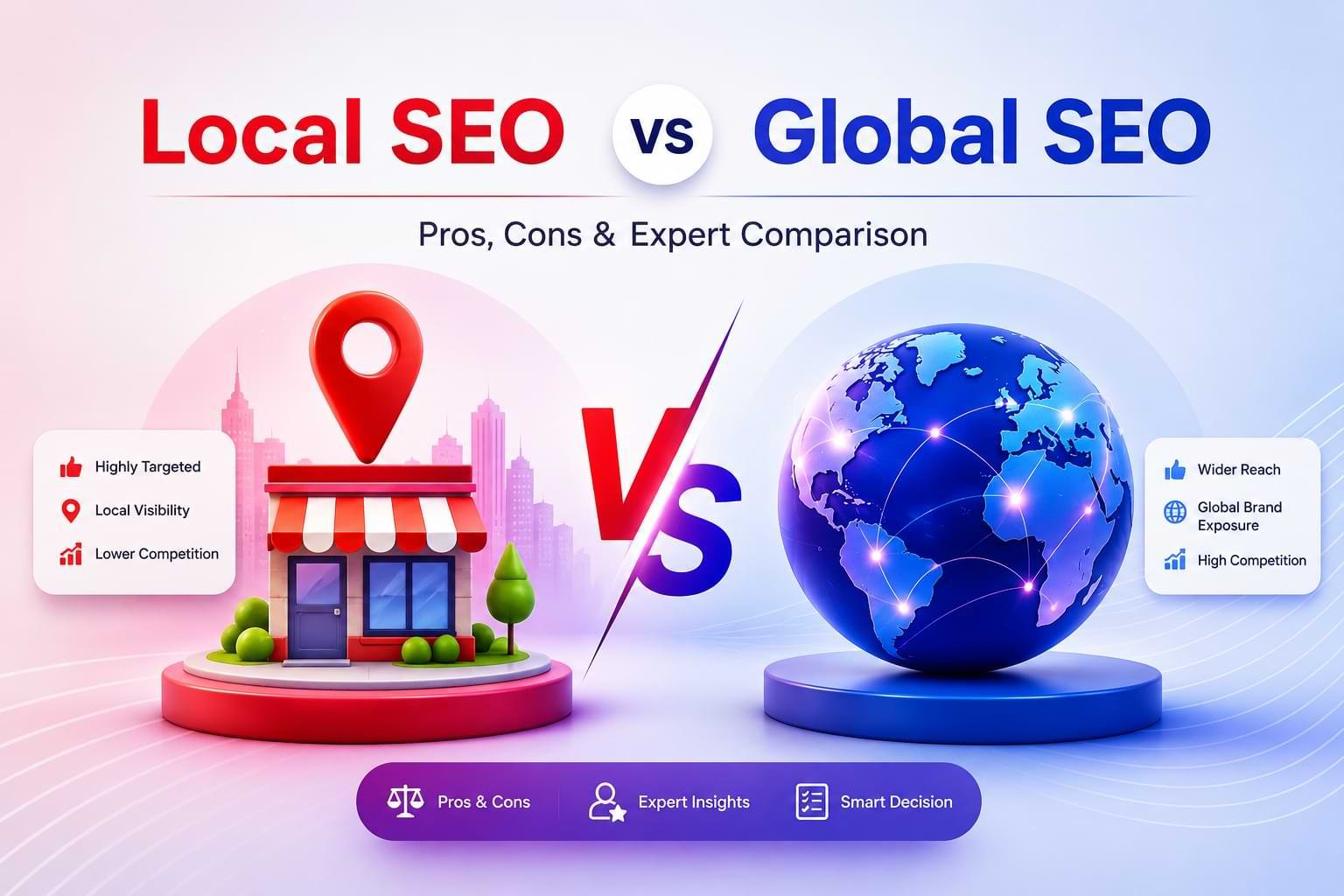
Local SEO gets your business found by people nearby who are ready to walk in or call today. Global SEO helps your business be found by people anywhere in the world who are searching in a different language, currency, or market altogether. Most businesses don’t need to pick one forever — they need to know which one to start with, and when the second one actually pays off.
If you’re comparing the two because you’re unsure where to allocate next quarter’s marketing budget, this breaks down the real differences, the honest tradeoffs, and how to determine which stage your business is actually in.
What Is Local SEO?

Local SEO is the work that gets your business found by people searching in a specific city, neighborhood, or service area. It’s built around three things: your Google Business Profile, location-based keywords, and signals that prove your business is real and physically present — like consistent name, address, and phone number (NAP) listings across the web.
If someone searches “Cuban restaurant near me” or “SEO agency Miami,” local SEO is what decides whether your business shows up in the map pack, the three-listing block Google shows above regular search results for location-based queries.
For a business with a physical location or a defined service area, this is usually where marketing dollars go first — it’s cheaper to rank for and it converts faster, because the person searching is often close to a buying decision.
What Is Global SEO?

Global SEO is the work that gets your website found by people searching in different countries or languages, regardless of where your business is physically based.
It relies on structural decisions — country-specific URLs, hreflang tags that tell Google which version of a page to show which audience, and content adapted to local language and currency, not just translated.
Global SEO makes sense for businesses selling digital products, software, or services that don’t depend on someone walking through a door.
The tradeoff is competition: instead of competing with other businesses in one city, you’re competing with every business targeting the same keyword worldwide. That drives up both the difficulty and the cost of ranking.
Local SEO vs. Global SEO: The Core Differences
| Factor | Local SEO | Global SEO |
|---|---|---|
| Audience | People in a specific city or service area | People across multiple countries or languages |
| Primary tool | Google Business Profile | Hreflang tags, ccTLDs or subdirectories |
| Competition level | Lower — you compete with nearby businesses | Higher — you compete worldwide for the same terms |
| Typical timeline to results | 2–4 months for map pack movement | 6–12+ months for competitive international terms |
| Cost | Lower — fewer pages, narrower keyword set | Higher — more content, more technical setup, more languages |
| Best fit | Businesses with a physical location or service radius | Businesses selling digitally or shipping internationally |
Local SEO vs. global SEO isn’t really a fight between two equally-weighted options — it’s a question of which stage your business is in. A new Miami business with one location almost always needs local SEO first. A business that’s already dominating its home market and has demand data from other countries is the one actually ready for global SEO.
Pros and Cons of Local SEO
Pros:
- Faster results — map pack rankings can shift in weeks, not months
- Lower cost — no multi-language content or international technical setup required
- Higher intent traffic — “near me” and city-based searches convert at higher rates because the searcher is closer to deciding
- Builds the review and citation foundation that global expansion later relies on
Cons:
- Caps your addressable market at your service area
- Vulnerable to local competitor moves — a nearby business investing heavily in its Google Business Profile can outrank you fast
- Doesn’t scale on its own if the business model isn’t location-dependent
Pros and Cons of Global SEO
Pros:
- Removes the geographic ceiling on traffic and revenue
- Diversifies risk — you’re not dependent on one local market’s economy or seasonality
- Positions the brand for AI Overview and AI Mode citations across a wider range of query phrasing, since broader entity coverage gives retrieval systems more to work with
Cons:
- Meaningfully more expensive — content, technical setup, and often local-language review all add cost
- Slower to show results against established international competitors
- Technical mistakes (bad hreflang implementation, duplicate content across country versions) can actively hurt rankings instead of just underperforming
How to Know Which One You Need
Run through these signals before spending on either:
- Check where your current traffic is already coming from. Pull the geographic breakdown in Google Search Console. If 90%+ of clicks are already from one metro area, local SEO is unfinished business — global is premature.
- Look at your business model, not your ambition. If revenue depends on foot traffic, service calls, or in-person appointments, local SEO is the ceiling and the floor. Global SEO doesn’t fix a business model that requires proximity.
- Check if demand already exists elsewhere. Look for organic traffic, direct visits, or inbound inquiries from outside your service area in your existing analytics. Unprompted demand is a stronger signal than a hunch.
- Price out the real cost of doing global SEO properly. If it means multi-language content, local reviewers, and technical hreflang work you can’t currently support, it’s not a “later this year” project — it’s a “next stage of the business” project.
- Audit your local rankings first. If you’re not consistently in the map pack for your core service terms locally, fix that before splitting attention and budget toward international competition.
For most businesses, the honest answer is: local SEO now, global SEO once local is actually saturated — not simultaneously from day one.
Can You Run Local and Global SEO Together?
Yes, and for a specific type of business, this is the right call from the start — not a later-stage upgrade. A bilingual, Miami-based company serving both local Spanish- and English-speaking clients and pursuing national or international work is a realistic example:
The local side still needs a fully optimized Google Business Profile and city-based content, while the broader side needs proper hreflang between English and Spanish content and a URL structure that doesn’t compete against itself.
The mistake to avoid is treating this as one strategy stretched thin. It’s two systems that share a domain: local pages stay locked to city-and-service-based keywords and a LocalBusiness schema, while broader-market pages use Organization schema, hreflang, and language- or country-based URL structures.
Mixing the two — say, putting hreflang tags on your local service pages, or trying to rank one page for both “Miami” and “worldwide” intent — usually hurts both efforts instead of helping either.
The Technical Checklist: What Actually Changes
The difference between local and global SEO isn’t just content — it’s structural. Here’s what actually changes in the build:
- Schema markup — local pages use
LocalBusinessschema with address, hours, and service area; global or multi-market pages useOrganizationschema with a broader entity description. - URL structure — local SEO typically doesn’t need a special URL pattern; global SEO requires a decision between ccTLDs (separate country domains), subdirectories (
/uk/,/es/), or subdomains — each with different link-equity tradeoffs, per Google’s own Search Central guidance on international targeting. - Hreflang tags — required for global SEO to tell Google which language/country version to serve; irrelevant for a single-location local site.
- NAP consistency — critical for local SEO across directories like Google Business Profile, Yelp, and industry-specific listings; not applicable to global-only pages.
- Content localization — global SEO needs content adapted to local currency, idiom, and search behavior, not machine-translated; local SEO needs content specific to neighborhoods and service areas instead.
- Crawler access — both need it, but global sites should confirm crawlers like Googlebot and increasingly GPTBot, PerplexityBot, and ClaudeBot can access and render every country/language version, not just the default one.
How AI Overviews Change This Comparison
This is the part most local-vs-global comparisons written before 2026 miss entirely: AI Overviews and AI Mode don’t treat local and global queries the same way a traditional ranked list does, and that changes what “winning” looks like for each strategy.
For local queries, AI Overviews tend to pull directly from Google Business Profile data, reviews, and structured local content — meaning a business with thin local SEO won’t just rank lower, it may not get surfaced in the AI-generated answer at all, since there’s less structured signal to cite.
For global or broader-market queries, AI Overviews and AI Mode draw from a wider pool of entity relationships across a site, which is part of why Organization schema and clear topical depth matter more for global SEO than keyword density ever did.
Search Console’s Generative AI performance reporting, expanded through 2026, is the clearest way to actually measure this instead of guessing — it shows impressions and clicks specifically from AI-powered search surfaces, broken out from standard organic results.
That’s a direct, checkable signal for whether local or global content is earning AI citations, not just traditional rankings.
A Real Audit Scenario From Our Miami Client Work

The question that comes up most often in Miami client audits isn’t “local or global” — it’s “we’re already ranking locally, so why aren’t we getting the out-of-state or international leads we know exist.” The audit process that answers that, as led by Muhammad Rehan Iqbal, Egochi’s Co-Founder and Content Strategy & Web Development Lead, starts in the same place every time: Search Console’s geographic query report, pulled before any recommendation gets made.
That report typically shows one of two patterns — either the traffic from outside the service area already exists and just isn’t converting because the site’s content and schema are still locally scoped, or it genuinely doesn’t exist yet and global investment would be premature.
The methodology matters more than the guess: a Google Business Profile audit, a Search Console geographic breakdown, and a competitor SERP scan for the target broader-market terms, in that order, before a single dollar moves toward global content.
FAQs
Do I need global SEO if I only sell in the US?
Not necessarily. If your customers are US-based but spread across multiple states, that’s usually nationwide SEO — broader keyword targeting and content, but without the hreflang, currency, and language work true global SEO requires. Global SEO specifically applies when you’re targeting audiences in other countries.
How much more does global SEO cost than local SEO?
Global SEO typically costs more because it requires content for multiple languages or markets, technical setup like hreflang, and often local reviewers to catch cultural or linguistic mistakes. Local SEO usually needs one well-optimized Google Business Profile and a narrower set of city-based pages, which costs less to build and maintain.
Can a Miami business rank locally and nationally at the same time?
Yes. This requires keeping local pages scoped to city-and-service keywords with LocalBusiness schema, while broader-market pages use Organization schema and their own keyword targeting — run as two coordinated systems rather than one stretched-thin strategy.
Does hreflang affect local SEO?
No. Hreflang is a global and international SEO tool used to tell Google which language or country version of a page to serve. A single-location local business generally doesn’t need it unless it’s also running multilingual content for a broader audience.
How long does it take to see results from global SEO?
Global SEO usually takes longer than local SEO — often six to twelve months or more for competitive international terms — because it involves higher competition and more technical complexity than a local Google Business Profile strategy. Local SEO can show measurable map pack movement within two to four months.