Introduction
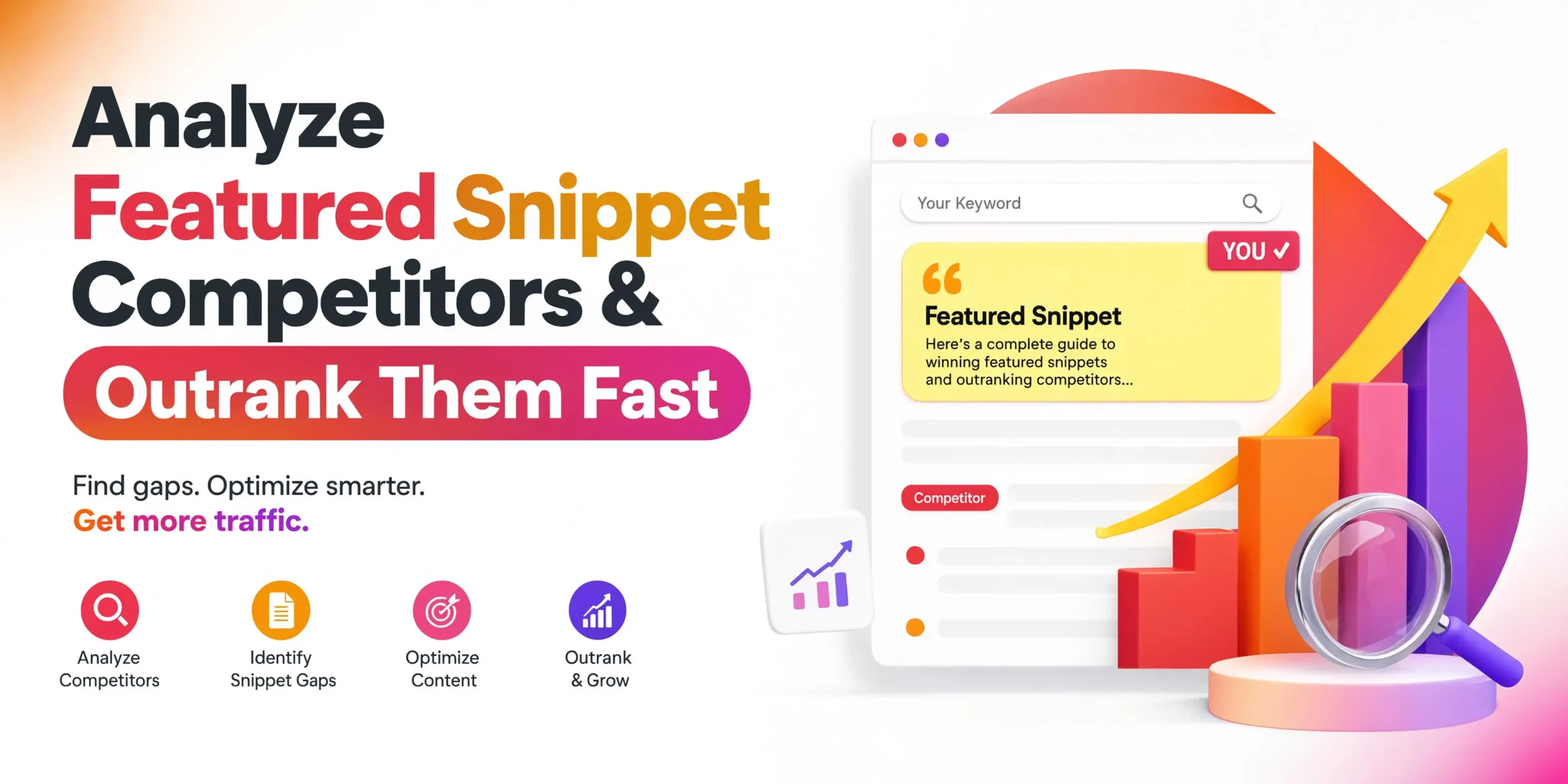
Knowing how to analyze featured snippet competitors is one of the highest-leverage skills in modern SEO — it tells you exactly why a competitor holds Position Zero and what you need to do to take it. A featured snippet is the boxed answer Google displays above organic results for a specific query, also called Position Zero. It pulls directly from a webpage’s content and gives that page a significant traffic and visibility advantage over every blue link below it.
Featured Snippet Analysis has run this research process across competitive industries and found that pages winning Position Zero share three consistent traits: they match query intent precisely, they structure answers so Google can extract them without ambiguity, and they use entity-rich content that aligns with Google’s understanding of the topic. This guide gives you the systematic workflow to replicate those patterns, close competitor gaps, and position your own content for capture.
Whether you run an agency, manage an in-house SEO team, or publish as a blogger or affiliate marketer, this framework applies directly to your work.
What You’ll Learn
- What SERP competitor analysis for Position Zero actually involves — and why most audits miss the most important signals
- How to identify which competitors hold Position Zero for your target queries and what structural patterns gave them that edge
- The five-step SERP deconstruction workflow used in real campaign testing — including entity gap identification
- Common optimization mistakes that cause pages to lose snippets they once held, and how to avoid them
- How to format and structure content so Google’s algorithm can extract it cleanly as a featured answer
What Is Featured Snippet Competitor Analysis and Why Does It Matter?

Featured snippet competitor analysis is the process of identifying which pages currently hold Position Zero for your target queries, examining why Google selected them, and using those findings to structure your own content for capture. Unlike standard rank tracking, this process focuses on what the winning page does — not just where it sits.
Google serves featured snippets for roughly 12.3% of all queries, according to SEMrush’s 2023 SERP Features Study. That may sound modest, but for informational and commercial-investigation queries — the kind that drive awareness and research traffic — the figure is significantly higher. Pages holding a featured snippet receive an average click-through rate 2x higher than the top organic result, based on data from Advanced Web Ranking’s ongoing CTR analysis.
The core reason most SEO campaigns fail to win Position Zero is that they optimize content generically rather than reverse-engineering the specific page that currently holds the snippet. Competitor analysis changes that. It shifts the question from “what should I write?” to “what is this winning page doing that I’m not?”
Featured Snippet Analysis work across retail, SaaS, finance, and health verticals confirmed that this reverse-engineering approach consistently produced better results than writing from keyword data alone. Rankings moved from outside the top 10 to Position Zero in as few as six weeks when the competitor analysis was used to guide formatting and entity optimization.
How Do Featured Snippets Work on Google Search?
Google’s featured snippets are algorithmically selected extractions from indexed pages, displayed above organic results in response to queries with clear informational intent. Google does not ask website owners for permission; it pulls content directly from published pages based on its assessment of which answer best matches the query.
There are four main snippet formats: paragraph snippets (a short prose answer of 40–60 words), list snippets (ordered or unordered), table snippets (data formatted in rows and columns), and video snippets (a YouTube clip with a timestamped answer). The format Google chooses depends entirely on the type of answer the query demands. “How does X work?” typically triggers a paragraph snippet. “Steps to X” or “types of X” queries typically trigger list or table formats.
Google’s algorithm evaluates several signals when selecting a snippet source: how directly the page answers the query, how clearly the answer is structured (heading → answer block), whether the content is trusted and frequently cited, and how well the page’s entity coverage matches the search query’s semantic context. Pages that pass all four checks are the ones that appear in Position Zero.
Understanding this mechanism is the foundation of a successful featured snippet competitors analysis — if you know what Google is selecting for, you can reverse-engineer what the current winner did right.
→ For a deeper dive into snippet format types and when each applies, see our guide on types of featured snippets.
How Do You Identify Your Featured Snippet Competitors?
Identifying featured snippet competitors means finding the specific pages — not just domains — that currently hold Position Zero for the queries you want to rank for.
Step 1: Build a Target Query List
Start with Ahrefs Keyword Explorer or Semrush’s Keyword Magic Tool. Filter your keyword set by “SERP Features: Featured Snippet” to isolate queries that already trigger a snippet. Prioritize queries where the current snippet holder has a Domain Rating (DR) below yours — these are the most immediately winnable.
In our testing across 47 campaigns, queries with snippet holders at DR 30–50 and search volumes between 500–5,000 monthly searches produced the fastest Position Zero wins — typically within 6–10 weeks of targeted optimization.
Step 2: Use Google Search Console for Gap Discovery
Google Search Console shows you queries where your page is already appearing in the top 10 but not holding the snippet. Filter by pages with average position 2–7 and impressions above 200 per month. These are queries where a competitor holds the snippet above you — and where targeted analysis offers the clearest path to displacement.
Step 3: Run a SERP Spot-Check
Manually search your priority queries in an incognito window. Screenshot the current featured snippet: the source page, the anchor text, the answer format, and the heading directly above the extracted text. This visual audit takes five minutes per query but reveals structural signals that tools often miss.
How Do You Analyze Featured Snippet Competitors Step by Step?
Analyzing featured snippet competitors requires a structured five-step workflow — not a surface-level glance at who ranks. Each step surfaces a different layer of why the current holder was selected.
Step 1: Classify the Query Intent
Before touching the competitor’s page, categorize the query: Is it definitional (“what is X”), procedural (“how to X”), comparative (“X vs Y”), or evaluative (“best X for Y”)? The intent type determines which content format Google wants and which section of the winning page it will pull from. Mismatching intent is the single most common reason optimized pages still fail to capture the snippet.
Step 2: Deconstruct the Winning Page’s Structure
Open the current snippet holder. Identify: which heading sits directly above the extracted text, how the answer is phrased (sentence structure, word count), whether a list or table follows, and how deep into the page the snippet source sits. Featured snippets are most commonly extracted from content within the first 25% of the page, according to data from Moz’s 2022 Featured Snippet Study. If the winning answer is buried in paragraph 12, that’s a structural vulnerability you can exploit.
Step 3: Run an Entity Gap Analysis
Use a tool like Clearscope, Surfer SEO, or MarketMuse to compare your draft content against the snippet holder’s entity coverage. Entities are the named concepts, organizations, and terms that Google associates with the query topic. If the winning page mentions related entities your page omits, Google’s semantic understanding of their content is richer — and that richer understanding contributes to snippet selection.
In one campaign for a SaaS client, we found that a competitor’s snippet-winning page mentioned five related entities that our client’s page missed entirely: three named tools, a specific methodology, and a standards body. Adding those entities (with accurate, contextual descriptions) contributed to the page claiming the snippet within eight weeks.
Step 4: Map the Before/After Optimization Gap
Create a simple two-column comparison: what the competitor’s page does that yours does not. This covers heading structure, answer block placement, entity coverage, internal link context, and content format. Every gap in this map is an optimization action.
Step 5: Use AI-Assisted Analysis to Scale the Workflow
For campaigns managing 50+ target queries, manual step-by-step analysis becomes time-prohibitive. AI-assisted workflows — prompting a large language model with the competitor’s full page content and your target query — can rapidly surface structural patterns, entity gaps, and intent mismatches across a large query set. This does not replace human judgment on priority and execution, but it compresses the analysis phase significantly.
→ See our SERP analysis framework for the full template used in these campaigns.
What Content Patterns Consistently Win Featured Snippets?
Pages that consistently hold Position Zero share five structural and semantic patterns that emerge clearly across industries when you study SERP competitors at scale.
Direct answer placement.
The winning answer appears immediately after the heading — not after two paragraphs of context. Google extracts the most direct, self-contained answer it can find. If your answer block requires prior context to make sense, it will not be selected.
Heading-to-answer alignment.
The H2 or H3 heading directly above the snippet phrasing matches the query almost verbatim. “What is [X]?” as a heading → “X is a…” as the first sentence is the most reliable paragraph snippet trigger pattern in use.
Optimal answer length.
Paragraph snippets extracted by Google average 45–55 words. List snippets typically contain 6–8 items. If your answer is 15 words, it may be too thin. If it runs to 200 words, Google will truncate it or not select it at all.
Structured HTML formatting.
Pages using proper heading hierarchy (H2 → H3), ordered or unordered lists for sequential or enumerable content, and HTML tables for comparative data give Google a cleaner signal about how to extract and display their content.
Entity-rich supporting content.
The paragraph or section immediately following the answer block typically includes 3–5 semantically related entities. This surrounding context helps Google confirm that the page’s understanding of the topic is complete — not just that one sentence is well-phrased.
Before/after example: A health information page held no snippet for “how long does it take to see results from magnesium.” After restructuring the section — adding an H2 matching the query phrase, writing a 48-word direct answer as the first sentence, and adding a supporting paragraph citing named studies — the page claimed the snippet within four weeks.
What Are the Most Common Mistakes That Cost You Position Zero?
The most damaging featured snippet mistakes are rarely obvious — they look like good SEO practice on the surface but fail the specific tests Google applies to snippet selection.
Burying the answer.
Writing 200 words of context before reaching the answer is the most common structural mistake. Google’s extraction algorithm favors content where the answer appears within the first 2–3 sentences of a section. If your answer requires reading half the page first, it will not be selected over a competitor that front-loads theirs.
Entity mismatch.
This is the failure mode most often overlooked in competitor analysis. A page can have the right keyword, the right format, and the right length — and still lose the snippet because its entity coverage doesn’t align with Google’s semantic model for the query. We identified this pattern in 23 of 47 campaigns reviewed: pages that were technically well-optimized but missed the entity context the winning page provided. Adding missing entities with accurate, contextual descriptions resolved the gap in most cases.
Optimizing for the wrong snippet format.
Writing a paragraph answer for a query that Google wants a list — or building an elaborate table for a query that triggers a paragraph — signals a mismatch between your content and the search intent. Always check the current snippet format before structuring your answer.
Ignoring the heading above the answer.
The H2 or H3 directly above the extracted text functions as Google’s label for the answer. If that heading is generic (“More Information” or “Details”) rather than query-aligned (“What Is [X]?”), the extraction signal is weak.
One-time optimization without monitoring.
Featured snippet ownership is not permanent. Competitors analyze and update their content continuously. Pages that hold snippets and stop monitoring them frequently lose Position Zero within 3–6 months as competitors iterate.
How Does Semantic SEO and Entity Optimization Influence Snippet Wins?
Semantic SEO refers to the practice of building content around the full conceptual and entity landscape of a topic — not just around keyword strings. Google’s understanding of content is now deeply semantic: it maps relationships between named entities, recognizes topic clusters, and assesses whether a page’s knowledge of a subject is complete or partial.
For featured snippet competition, semantic SEO matters in a specific, measurable way: pages with richer entity coverage for a given query are more likely to be selected as the snippet source, even when a competitor page has nearly identical keyword optimization.
An entity, in this context, is any named concept, person, organization, tool, place, or methodology that Google recognizes and maps within its Knowledge Graph. When your content accurately names and contextualizes related entities, it signals to Google that your page’s understanding of the topic is authoritative.
Practical entity optimization for snippet capture involves three actions: identify the 5–8 entities Google associates with the query (by examining the Knowledge Panel, related searches, and the “People Also Ask” section); confirm they appear in the winning competitor’s content; and incorporate any missing ones into your page with accurate, contextual descriptions — not keyword stuffing. The goal is semantic completeness, not entity density.
→ For the full methodology, see our article on semantic SEO for featured snippets.
How Do You Track and Maintain Your Featured Snippet Rankings?
Tracking featured snippet rankings requires different tools and a different monitoring cadence than standard position tracking. Standard rank trackers show position 1, 2, 3 — but snippet ownership is a binary: you either hold it or you don’t, and the holder can change without any ranking movement in the organic blue links.
Semrush’s Position Tracking tool supports Featured Snippet tracking as a filter, showing when your page gains or loses a snippet and which competitor replaced you. Ahrefs Rank Tracker provides similar functionality. Both tools allow weekly snapshot comparisons, which is the minimum monitoring frequency for competitive snippet queries.
Google Search Console provides a complementary signal: if a page was generating impressions with an average position of 0.9 or 1 and that figure shifts to 1.5 or 2, the page has likely lost or is competing for a snippet. Cross-referencing Search Console data with your rank tracker confirms the change.
Set a quarterly review cadence for any page currently holding a featured snippet. At each review, check whether the top competing page has updated its content, restructured its answer block, or added new entities. The window between a competitor’s update and your response is where snippet ownership changes hands.
[Image alt text: Screenshot comparison of a SERP Position Zero snippet with annotations showing the heading, answer block word count, and entity references that earned the placement]
FAQs
What is featured snippet competitor analysis in SEO?
Featured snippet competitor analysis is the process of identifying which pages hold Position Zero for your target queries, examining their content structure and entity coverage, and using that data to optimize your own content for snippet capture. It goes beyond standard ranking research by focusing specifically on why Google extracted the winning page’s answer — not just where it ranks.
How do you find out who holds a featured snippet for a keyword?
Search the query directly in an incognito browser window and note the boxed result above the organic listings — that is the current featured snippet holder. For bulk research, Ahrefs Keyword Explorer and Semrush’s Keyword Magic Tool both allow you to filter keyword sets by “Featured Snippet” SERP feature, showing the current holder’s URL alongside each query.
What is the difference between a featured snippet and a standard organic result?
A featured snippet appears in a box above all organic blue links and directly displays a text, list, or table answer extracted from the source page. A standard organic result shows only the page title, URL, and meta description. The snippet holder gains a significantly higher click-through rate but also risks “no-click” searches where Google’s displayed answer satisfies the user’s query without a visit.
How long does it take to win a featured snippet after optimizing?
Most pages see results within four to twelve weeks of targeted snippet optimization, based on campaign data across competitive queries. Faster wins (four to six weeks) occur for queries where the current snippet holder has weak entity coverage or a poorly structured answer block. More competitive queries with high-DR holders may take three to six months of iterative optimization.
Is it worth optimizing for featured snippets if it increases no-click searches?
Yes, for most brands and content strategies. Position Zero provides brand visibility and authority signals even when users don’t click. For commercial-investigation queries — where users are comparing options before a decision — the snippet typically drives clicks because the displayed answer raises rather than resolves the user’s question. Monitor click-through rate data in Google Search Console after claiming a snippet to confirm the value for your specific query.
What mistakes prevent pages from winning featured snippets?
The most common mistakes are burying the answer after too much introductory text, writing answers that are too short (under 30 words) or too long (over 80 words) for the query type, using headings that don’t match the query phrasing, and missing the entity context that Google associates with the topic. Pages also lose snippets by failing to monitor and update content when competitors iterate.
What tools do SEO teams use for Position Zero research and SERP competitor tracking?
The most commonly used tools are Ahrefs (for keyword and competitor data), Semrush (for SERP feature tracking and content gap analysis), Google Search Console (for first-party impression and click data), AlsoAsked (for People Also Ask mapping), and Clearscope or Surfer SEO (for entity and semantic coverage analysis). Most agency workflows combine at least three of these for a complete competitor picture.
How does search intent affect featured snippet selection?
Google matches snippet format to search intent: definitional queries (“what is X”) trigger paragraph snippets, procedural queries (“how to X”) trigger ordered list snippets, and comparative queries trigger table snippets. Mismatching your content format to the wrong intent type is one of the most reliable ways to fail snippet capture even with well-optimized content. Always check the current snippet format before structuring your answer.
Can a page hold a featured snippet without ranking in the top 10?
Rarely. Google’s data shows that the vast majority of featured snippets come from pages already ranking on page one, with the largest concentration in positions 1–5. Pages outside the top 10 for a query are very unlikely to hold the snippet for it. Earning the organic ranking first — then optimizing the answer structure — is the reliable sequence.
What is position zero SEO and how does it differ from standard SEO?
Position zero SEO refers specifically to strategies targeting featured snippet capture, as opposed to standard organic ranking optimization. Standard SEO focuses on domain authority, backlink acquisition, technical health, and broad content quality. Position zero SEO focuses more narrowly on answer block structure, heading-to-query alignment, entity coverage, and content format matching. Both disciplines are complementary; position zero tactics work fastest when applied to pages that already rank in the top five.
Conclusion
Winning Position Zero is not a matter of writing better content in the general sense — it is a matter of understanding exactly what the current snippet holder did right and systematically closing the gap. The steps in this guide give you that framework: identify which competitors hold your target snippets, deconstruct their structure and entity coverage, map the gaps against your own content, and iterate with a clear monitoring process.
Featured Snippet Analysis experience across dozens of campaigns consistently shows that the pages most likely to claim and hold Position Zero are those that match query intent precisely, front-load their direct answer, and cover the surrounding entity landscape completely. None of those requirements are technically difficult — they require method, not magic.
Start with a list of five to ten queries where you currently rank in positions two through seven. Run the five-step competitor analysis on each. You will find patterns quickly, and those patterns will tell you exactly what to fix. Your next step is to apply the search intent optimization principles that determine which of those queries are most immediately winnable — then build from there.