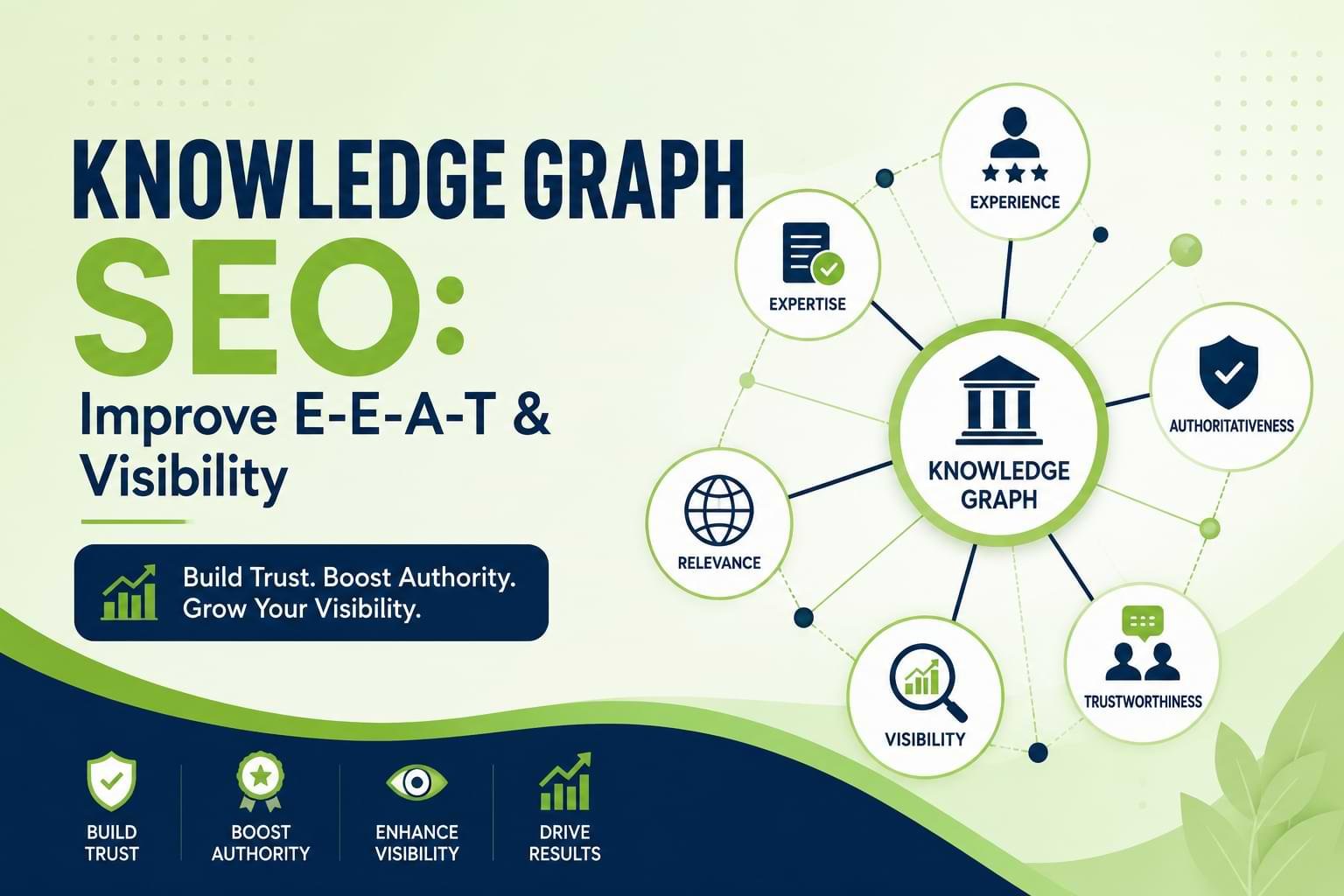
Introduction
Knowledge Graph SEO is the practice of helping Google recognise your website, brand, or person as a verified, well-connected entity in its Knowledge Graph — so your content gets treated as a trusted source rather than just a collection of keyword-matched pages.
If Google doesn’t understand what your site is, it struggles to decide when to show it. That gap between existing in the index and being understood as an authority is exactly what Knowledge Graph SEO addresses.
This guide was researched and written by M. Rehan, a web developer and SEO and technical content specialist who works with structured data implementation and entity-based optimisation strategies. The research process involved reviewing Google’s publicly available documentation, Schema.org specifications, Google’s Search Quality Evaluator Guidelines (2026 edition), and documented patterns in Knowledge Graph inclusion across multiple site types.
What Is the Google Knowledge Graph?

The Google Knowledge Graph is a large-scale knowledge base that Google uses to understand real-world entities — people, places, organisations, and concepts — and the relationships between them.
Google announced the Knowledge Graph in May 2012. Amit Singhal, then Senior Vice President of Search at Google, described the shift in a blog post titled “Introducing the Knowledge Graph: things, not strings” on the Google Official Blog. The core idea: Google would move from matching keywords to understanding meaning.
Instead of treating the query “Leonardo da Vinci” as a string of characters to match, Google began recognising it as a reference to a specific historical person — with relationships to the Italian Renaissance, The Last Supper, the Louvre, and dozens of other entities.
From “Strings” to “Things”: How Google Shifted to Entity-Based Search
Before the Knowledge Graph, Google matched your search query to web pages that contained similar words. The system was effective but limited — it couldn’t distinguish between the band “The Cure” and a medical cure, or between “Apple” the company and apple the fruit, without relying heavily on surrounding context.
The Knowledge Graph gave Google a structured way to represent what things are, not just what words appear near them. This semantic layer sits beneath keyword matching and increasingly determines which content Google treats as authoritative.
How the Knowledge Graph Stores and Connects Information
The Knowledge Graph stores information as connected triples: subject → relationship → object. For example: [Leonardo da Vinci] → [painted] → [The Last Supper]. These structured relationships allow Google to answer complex queries, populate Knowledge Panels, and feed its AI Overviews with factual, citable information.
Google draws data for the Knowledge Graph from structured sources including Wikipedia, Wikidata, and licensed databases — as well as from structured data on web pages, particularly JSON-LD schema markup using Schema.org vocabulary.
Why Knowledge Graph SEO Matters for Your Site
If your site, brand, or personal profile exists as a recognised entity in the Knowledge Graph, Google can do something it cannot do with unrecognised sites: assign contextual authority.
This matters beyond rankings. When Google understands your entity, it can:
- Surface a Knowledge Panel for your brand in search results
- Include your content in AI Overviews as a cited, named source
- Associate your site with specific topical areas, strengthening ranking signals across related queries
- Distinguish your brand from similarly named competitors through entity disambiguation
Knowledge Graph Signals That Affect Rankings
Google’s systems use entity recognition as one input among many in determining ranking authority. The effect is not a direct ranking boost from schema markup alone. Rather, entity recognition allows Google to build a more complete picture of what your site covers, who created it, and whether those signals are corroborated by external sources.
Sites with strong entity signals tend to accumulate topical authority more consistently — meaning a new piece of content on a related topic inherits some of that authority rather than starting from zero.
The Connection Between Entity Recognition and E-E-A-T
Google’s Search Quality Evaluator Guidelines (2024 edition) describe E-E-A-T — Experience, Expertise, Authoritativeness, and Trustworthiness — as the framework its quality raters use to assess content quality. Knowledge Graph inclusion is not a direct E-E-A-T signal, but the two systems reinforce each other.
An entity with verified authorship information, consistent organisation details, and corroborating external references satisfies multiple E-E-A-T criteria simultaneously. The Knowledge Graph is, in practice, one of the mechanisms through which Google operationalises E-E-A-T at scale.
How Google Identifies and Validates Entities
Most practitioners treat Knowledge Graph optimisation as a single-phase task: add schema markup, wait for Google to index it, and expect recognition. In practice, Google’s entity validation appears to operate in two distinct stages, and confusing them leads to stalled implementations.
Stage 1 — Initial Identification:
Google encounters signals that suggest an entity exists. These signals include on-page structured data, consistent brand mentions, and the presence of an About page or author bio with named attributes.
Stage 2 — Corroboration:
Google cross-references those signals against independent, third-party sources to confirm the entity is real, established, and accurately described. This is the stage most sites never reach — because corroboration requires external validation that on-page optimisation cannot provide.
The practical implication: if your Knowledge Graph strategy begins and ends with schema markup, you’ve completed Stage 1 but left Stage 2 entirely to chance.
Primary Entity Signals Google Uses
| Signal Type | Examples | Influence Level |
|---|---|---|
| Structured data (on-page) | JSON-LD: Organization, Person, LocalBusiness | Foundation — necessary but not sufficient |
| Wikipedia / Wikidata entries | Named article or Wikidata Q-item | High — strongly corroborates entity existence |
| Google Business Profile | Verified listing with consistent NAP | High for local entities |
| Official website / About page | Clearly identified entity with verifiable attributes | Moderate — necessary baseline |
| Brand mentions in authoritative sources | Press coverage, industry publications | High — third-party corroboration |
| Social media profiles | LinkedIn, Twitter/X, YouTube — consistent entity name | Moderate — confirmation signal |
| Knowledge Panel (existing) | Already recognised entities | Very high — reinforcing signal |
Secondary Confirmation Signals
Secondary signals include: co-citations alongside already-recognised entities, SERP feature appearances, branded search volume, and backlinks from domains that themselves have Knowledge Graph entity status. These signals are harder to build deliberately but accumulate naturally for entities that have completed Stage 2 validation.
Schema Markup vs. the Knowledge Graph: What’s the Actual Difference?
Schema markup and the Knowledge Graph are related but functionally distinct. Confusing them leads to misaligned expectations and wasted implementation effort.
Schema markup is code you add to your web pages, written in JSON-LD (or Microdata, or RDFa), using the vocabulary defined at Schema.org. It tells search engines what your content represents — a person, a product, an article, a local business — in machine-readable format.
The Knowledge Graph is Google’s internal database of entities and relationships. It is not something you add to directly. You cannot submit an entity to the Knowledge Graph the way you submit a URL to Google Search Console.
The relationship: schema markup is one of the signals Google uses when deciding whether to add or update an entity in the Knowledge Graph. It is a communication tool, not a direct entry mechanism.
| Attribute | Schema Markup | Google Knowledge Graph |
|---|---|---|
| What it is | Code on your web pages | Google’s internal entity database |
| Who controls it | You (the site owner) | |
| How it’s created | You write and deploy it | Google builds it from multiple signals |
| Direct submission | Yes — you add it to your site | No — Google decides what enters |
| Effect on SERPs | Enables rich results, structured snippets | Enables Knowledge Panels, entity-based ranking |
| Relationship to E-E-A-T | Supports entity attribute communication | Reflects accumulated entity authority |
| Required vocabulary | Schema.org | N/A — Google’s internal ontology |
What Schema Markup Does (and What It Doesn’t Do)
Schema markup enables Google to read your content as structured data rather than unstructured text. It increases the probability that Google correctly identifies your entity and its attributes. It also enables specific SERP features — FAQ rich results, review stars, product pricing, and others — that are separate from Knowledge Graph inclusion.
What schema markup does not do: guarantee Knowledge Graph inclusion, directly improve keyword rankings, or substitute for the external corroboration signals Google needs to validate an entity.
How Structured Data Supports Knowledge Graph Inclusion
JSON-LD using Schema.org’s Organization, Person, LocalBusiness, or WebSite types provides Google with machine-readable entity attributes: name, URL, logo, founding date, location, and social profile links. The sameAs property is particularly important — it connects your entity to existing Knowledge Graph nodes (Wikipedia pages, Wikidata Q-items, social profiles) and helps Google confirm you’re describing a known entity rather than an unknown one.
How to Optimise Your Site for Knowledge Graph SEO — Step-by-Step
This process covers both on-page implementation and the off-page corroboration work that most guides omit. Both stages are required for consistent results.
Step 1 — Establish Your Core Entity (Person, Organisation, or Place)
Decide which entity type your site represents. Most business sites represent an Organization. Personal brand sites represent a Person. Local businesses represent a LocalBusiness (a subtype of Organization under Schema.org vocabulary).
Your entity must be clearly and consistently described across your site. Your About page, homepage, and contact page should all describe the same entity with the same name, location, and attributes. Inconsistency across these pages creates conflicting signals that slow entity recognition.
Step 2 — Implement JSON-LD Schema Markup
Add JSON-LD structured data to your homepage and About page at minimum. For an Organisation entity, include:
@type: Organization (or LocalBusiness)name: Egochi Miami Seo Agencyurl: https://egochimiamiseoagency.com/logo: URL of your logo imagesameAs: array of your Wikipedia URL, Wikidata Q-item URL, LinkedIn, and other verified profilesfoundingDate,https://egochimiamiseoagency.com/description,contactPoint: where accurate data exists
Step 3 — Build Entity Signals Across the Web
This is Stage 2 of the validation process — corroboration. Publish or secure:
- A Wikidata entry for your organisation or personal brand (if your entity meets notability criteria)
- Consistent listings in relevant business directories with exactly matching NAP (name, address, phone number)
- Press coverage or mentions in established industry publications
- A LinkedIn company page or personal profile linked to your website via the
sameAsproperty - Author profiles on authoritative platforms that link back to your site
Each of these creates an independent reference point that Google can use to cross-check the entity attributes you declared in your schema markup.
Step 4 — Claim and Optimise Your Knowledge Panel
If a Knowledge Panel already exists for your entity, Google provides a “Claim this knowledge panel” option accessible via a verified Google account associated with your entity. Claiming the panel allows you to suggest corrections — you cannot directly edit all fields, but corrections submitted through the verification process are reviewed.
If no panel exists yet, continue building corroboration signals. Knowledge Panels appear when Google has sufficient confidence in an entity’s identity and relevance. There is no minimum threshold publicly stated by Google.
Step 5 — Monitor Entity Recognition with Available Tools
Google Search Console shows how your site appears in search, including branded query performance, which is one proxy for entity recognition strength. Searching Google for your brand name and observing whether a Knowledge Panel, rich results, or entity-based SERP features appear is the most direct visible indicator.
Third-party tools including Semrush’s Knowledge Graph tracking features and similar tools in Ahrefs allow monitoring of entity-related SERP features over time.
E-E-A-T and the Knowledge Graph: How They Reinforce Each Other

Google’s Search Quality Evaluator Guidelines (2026 edition) make clear that E-E-A-T is not a single score or algorithm — it is a framework used by human quality raters to assess whether content demonstrates real expertise, genuine experience, recognised authority, and verifiable trustworthiness.
The Knowledge Graph contributes to this framework by giving Google a structured way to verify that the entity behind a piece of content is who they claim to be.
Experience and Expertise Signals in the Knowledge Graph
When an author or organisation is recognised as a Knowledge Graph entity, their name becomes associated with specific topical domains, credentials, and relationships to other entities. A medical doctor with a Knowledge Graph entity tied to a hospital, a published book, and coverage in health publications carries a different entity profile than an anonymous byline — even if the on-page content is identical.
For this reason, building named authorship into your content strategy — with consistent author schema (@type: Person with sameAs links to verified profiles) — directly supports E-E-A-T signals in a way Google can evaluate systematically.
Authority and Trust: What Google’s Quality Guidelines Say
The 2024 edition of Google’s Search Quality Evaluator Guidelines defines “Authoritativeness” partly in terms of recognition by other entities in a field — mentions, citations, and references from established sources. This mirrors the Knowledge Graph’s own corroboration model: authority is established externally, not self-declared.
In our assessment, the most practically significant overlap between E-E-A-T and Knowledge Graph SEO is at the Trust layer. Sites whose entity attributes — name, authorship, location, contact information — are verifiable, consistent, and corroborated by third-party sources satisfy both Trust (for E-E-A-T purposes) and the corroboration requirement for Knowledge Graph validation simultaneously.
Knowledge Panel Optimisation: Getting and Managing Your Panel
A Google Knowledge Panel is a structured information box that appears on the right side of Google search results (on desktop) or at the top of results (on mobile) when someone searches for a specific entity.
Knowledge Panels are algorithmically generated by Google. They pull data from the Knowledge Graph — which means your Knowledge Panel content reflects what Google has confirmed about your entity, not just what you’ve told it.
What Triggers a Knowledge Panel
Google generates a Knowledge Panel when three conditions are broadly met: the entity is clearly identified (consistent entity signals across multiple sources), the entity has sufficient notability (third-party references from established sources), and Google has enough structured data to populate the panel fields.
There is no single action that triggers a Knowledge Panel. The process is cumulative and involves both on-page signals (schema markup, About page clarity) and off-page corroboration (Wikipedia, Wikidata, press coverage, consistent directory listings).
How to Claim Your Knowledge Panel
Search for your entity by name. If a panel exists, look for the “Claim this knowledge panel” prompt beneath the panel. You’ll need to verify ownership through a Google account associated with your entity — typically via your Google Search Console property or an official social media account.
Once claimed, you can suggest corrections to panel information. Approved corrections update within Google’s review cycle, which varies without a publicly stated timeline.
Knowledge Graph SEO for Local Businesses
Local businesses have a more direct path to Knowledge Graph recognition than most entity types, because Google Business Profile (formerly Google My Business) is directly integrated with Google’s local entity systems.
Local Entity Signals That Matter Most
For a local business entity, the highest-influence signals are:
- A verified, complete Google Business Profile with accurate NAP data
- Consistent NAP across all directory listings (Yelp, Bing Places, Apple Maps, industry-specific directories)
LocalBusinessschema on your website using the same NAP as your Google Business Profile- Customer reviews on Google, which contribute to entity reputation signals
- Local press mentions or citations that include your exact business name and location
Google Business Profile and Knowledge Graph Alignment
Your Google Business Profile is effectively a structured entity submission to Google’s local knowledge base. The data you enter — business name, category, address, hours, website — feeds directly into the local variant of the Knowledge Graph. This makes Google Business Profile the most important single action for local businesses pursuing Knowledge Graph visibility.
The sameAs property in your LocalBusiness schema should link to your Google Business Profile URL, Yelp listing, and any other verified directory profiles. This cross-linking strengthens entity corroboration across sources.
Expert Tips for Knowledge Graph SEO
Expert Tip 1 — Use Wikidata Before Wikipedia
Wikipedia has strict notability criteria that most businesses and individuals don’t meet. Wikidata has lower barriers to entry and is a direct data source that Google draws from for Knowledge Graph information. Creating a Wikidata entry for your entity — with accurate, sourced attributes and your website URL — is often faster and more achievable than pursuing a Wikipedia article.
Expert Tip 2 — The sameAs Property Is Your Cross-Reference Chain
The sameAs property in your JSON-LD schema is the most direct way to connect your on-page entity declaration to external knowledge base records. Include links to your Wikidata Q-item, Wikipedia article (if one exists), LinkedIn, and any other verified entity profiles. Each link gives Google an additional corroboration point.
Expert Tip 3 — Consistent Entity Name Across Every Surface
The single most common cause of stalled Knowledge Graph recognition is inconsistent entity naming. “M. Rehan Consulting,” “MRehan Consulting,” and “M Rehan” are three different strings to Google’s systems. Pick one canonical entity name and use it verbatim across your website, schema markup, directory listings, social profiles, and press mentions.
Expert Tip 4 — Branded Queries Are a Proxy Metric
You cannot directly measure Knowledge Graph recognition through standard analytics. One practical proxy: track branded query impressions in Google Search Console over time. Growing branded search volume combined with the appearance of SERP features (sitelinks, Knowledge Panel) signals improving entity recognition. Flat branded impressions despite content growth can indicate weak entity signals.
Expert Tip 5 — Author Schema Accelerates Personal Brand Recognition
For content-driven sites, adding @type: Person schema with sameAs links for every named author — linked to their LinkedIn, Wikidata entry, or Google Scholar profile if applicable — is one of the most underused entity signals. It connects named content creators to their professional entity records, which supports E-E-A-T at the author level rather than only at the site level.
Common Knowledge Graph SEO Mistakes
Mistake 1 — Treating Schema Markup as a Ranking Shortcut
Schema markup does not directly improve keyword rankings. It communicates entity attributes to Google’s systems. Sites that add schema markup and expect an immediate rankings increase misunderstand what the signal does — and when those results don’t appear, they often abandon a strategy that was actually working at the entity recognition level, just not at the keyword ranking level they were measuring.
Why it happens: schema markup is often discussed in the same breath as ranking improvements, which creates an expectation it doesn’t reliably fulfil on its own.
How to avoid it: measure the right outcomes — Knowledge Panel appearance, rich result eligibility, and AI Overview citation frequency — rather than short-term keyword position changes.
Mistake 2 — Inconsistent NAP and Entity Data Across the Web
If your business is listed as “Egochi Miami SEO Agency” on your website but “Egochi SEO Miami” on Yelp and “Egochi Digital” on a local directory, Google’s entity resolution systems treat these as potentially different entities. The corroboration signals cancel out rather than accumulate.
Why it happens: directory listings accumulate over time through automatic aggregation, and businesses rarely audit them.
How to avoid it: run a NAP consistency audit across your top 20–30 directory listings annually. Tools like BrightLocal can automate this check.
Mistake 3 — Ignoring Wikipedia and Wiki data as Authority Sources
Many practitioners skip Wiki data because it feels unfamiliar or because they assume their entity doesn’t qualify. Wiki data’s criteria are significantly more permissive than Wikipedia’s — most established businesses and professionals can create a Wiki data entry with accurate, sourced information. Since Google draws directly from Wiki data as a Knowledge Graph source, this is one of the highest-leverage actions available.
Why it happens: the SEO community has historically focused on Wikipedia, which has stricter editorial requirements, leading to the assumption that both are equally difficult.
How to avoid it:
Check whether your entity has a Wikidata Q-item. If not, create one with accurate attributes and link it via sameAs in your schema.
Mistake 4 — Conflating Keyword SEO with Entity SEO
Keyword SEO targets what users type. Entity SEO targets what Google understands. These are related but distinct objectives, and the tactics that serve one don’t automatically serve the other.
A site optimised entirely for keyword density and backlink acquisition may still be invisible to Google’s entity systems — meaning it gets no Knowledge Panel, no AI Overview citations, and no entity-based authority accumulation.
Why it happens: keyword SEO is older, better documented, and more directly measurable, so it dominates most practitioners’ mental models.
How to avoid it: build entity optimisation as a parallel track, not as a replacement for keyword strategy. The two reinforce each other when implemented together.
FAQs
Does schema markup guarantee Knowledge Graph inclusion?
No. Schema markup is one signal Google uses when evaluating whether to include or update an entity in the Knowledge Graph. It increases the probability of recognition by clearly communicating entity attributes, but it does not guarantee inclusion.
Google requires corroboration from independent third-party sources before adding or confirming an entity — and that corroboration must come from off-site signals that schema markup cannot replace.
How long does it take to appear in the Knowledge Graph?
There is no publicly stated timeline from Google. Based on documented patterns, entities with strong third-party corroboration — an existing Wikipedia or Wikidata entry, press coverage, and verified directory listings — can appear in the Knowledge Graph within weeks of adding schema markup. Entities building those corroboration signals from scratch may wait months. The process is not linear, and Google does not provide status notifications.
Can small businesses benefit from Knowledge Graph SEO?
Yes — and local businesses in particular have an accessible entry point through Google Business Profile verification, which directly feeds Google’s local entity systems.
Small businesses with verified profiles, consistent NAP data, and LocalBusiness schema markup can achieve Knowledge Panel visibility without needing Wikipedia articles or major press coverage. The threshold for local entity recognition is lower than for national or personal brand entities.
What is the difference between a Knowledge Panel and the Knowledge Graph?
The Knowledge Graph is Google’s internal database of entities and relationships — it is not visible to users directly. A Knowledge Panel is a visible SERP feature that Google generates using information from the Knowledge Graph.
Think of the Knowledge Graph as the database and the Knowledge Panel as one of the interfaces Google builds on top of it. You can influence the Knowledge Panel only by improving the underlying entity signals that feed into the Knowledge Graph.
Does Knowledge Graph SEO help with AI Overviews?
The evidence suggests yes, in an indirect but meaningful way. Google’s AI Overviews draw on structured, entity-anchored information when generating responses — and entities with confirmed Knowledge Graph status are more likely to be cited as named sources.
Sites whose entities are recognised and whose content is structured for direct answers are more consistently cited in AI Overview responses than sites relying on keyword density alone. This is consistent with Google’s stated goal of surfacing content from trusted, verifiable entities.
Conclusion
Knowledge Graph SEO is not a single tactic — it is a parallel track of entity recognition work that runs alongside your keyword and content strategy. When both operate together, Google’s systems can do more than rank your pages: they can understand what your site represents, associate it with specific areas of expertise, and surface it in formats — Knowledge Panels, AI Overviews, rich results — that keyword optimisation alone doesn’t reach.
The most common reason sites stall in this process is treating schema markup as the entire solution. Schema markup is Stage 1. Corroboration — through Wikidata, consistent directory listings, press mentions, and author profiles — is Stage 2.